
Stenamma
Westwood, 1839
cryptic leaf-litter ants
Species Guides
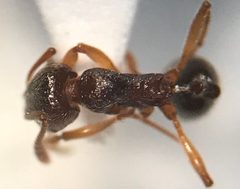
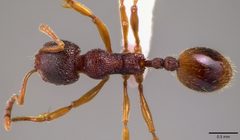
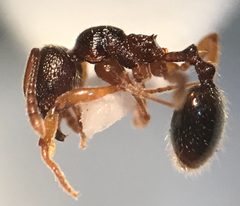
7Stenamma is a of cryptic ants in the Formicidae, Myrmicinae. The genus was long thought to be restricted to temperate regions, but extensive Neotropical collections have revealed a major radiation in Middle America with 40 recognized , 33 of them newly described. Species are notably adapted to cool, wet environments at mid to high elevations, where they can become the genus in leaf-litter —contrary to the typical ant pattern of decreasing diversity with elevation.
Pronunciation
How to pronounce Stenamma: /stɛˈnæmə/
These audio files are automatically generated. While they are not always 100% accurate, they are a good starting point.
Identification
Stenamma are cryptic ants characterized by small colonies of slow-moving . The was redefined taxonomically with a new of the worker ; molecular data confirm it as monophyletic and sister to Aphaenogaster and Messor. Species-level identification requires detailed morphological examination; a revision of the Middle American clade provides keys for 40 species.
Images
Habitat
Mesic forest including temperate and tropical regions. Nests occur in diverse microhabitats: leaf litter, large logs, rotting branches, bark, steep clay or mud banks, epiphytes, rocks, ground, and forest . Many are specifically adapted to cool, wet cloud forest environments at elevations above 800 m.
Distribution
Holarctic region, Central America, and northwestern South America (Colombia and Ecuador). The Middle American clade shows extensive radiation. Stenamma striatulum has been recorded in Germany and Switzerland, with potential range expansion.
Behavior
are slow-moving and form small colonies. Some exhibit complex nesting : constructing architecturally sophisticated elevated nest entrances, maintaining multiple identical nests while occupying only one with and , and using a round clay 'door-pebble' to plug the entrance when threatened by army ants. Multiple species have convergently evolved this door-pebble behavior in clay bank .
Ecological Role
In cool, wet cloud forest localities, Stenamma has been observed to be the most common in leaf-litter , dominating local ant in these specific conditions.
Human Relevance
The serves as a model system for studying , temperate-to-tropical , and montane . Montane may be vulnerable to climate change. Taxonomic revisions provide identification tools for ecologists and conservation biologists.
Similar Taxa
- LordomyrmaFormerly included Stenamma bhutanensis and S. sinensis, which were transferred to this based on and molecular data.
- PropodilobusNew erected for Stenamma pingorum based on compelling morphological differences; not congeneric with Stenamma.
- AphaenogasterMolecular data indicate Stenamma forms a clade with Aphaenogaster and Messor; these are phylogenetically close but morphologically and ecologically distinct.
- MessorMolecular data place Messor as sister to the Stenamma-Aphaenogaster clade; Messor are typically granivorous and found in arid , contrasting with Stenamma's mesic forest specialization.
Sources and further reading
- BugGuide
- Wikipedia
- GBIF taxonomy match
- iNaturalist taxon
- NCBI Taxonomy
- Catalogue of Life
- Why He Studies Ants | Bug Squad
- President's Prize | Bug Squad
- The peculiar life history of Middle American Stenamma ants | Blog
- Pensoft blog - Part 143
- A new ant in Germany, Stenamma striatulum Emery, 1895 (Hymenoptera: Formicidae)
- Demography and Reproduction in the Cavity-dwelling Ant Stenamma diecki (Emery) (Hymenoptera: Formicidae)
- The ant genus Stenamma Westwood (Hymenoptera: Formicidae) redefined, with a description of a new genus Propodilobus
- Complex Nesting Behavior by Two Neotropical Species of the Ant Genus Stenamma (Hymenoptera: Formicidae)1