
Stenamma diecki
Emery, 1895
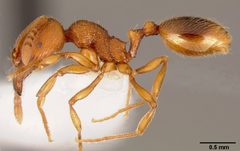
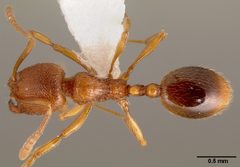
Stenamma diecki is a of cavity-dwelling in the Stenamma, described by Emery in 1895. In the northeastern United States and southern Michigan, it occurs alongside other Stenamma species but is not abundant at southern latitudes. Near Montreal, Quebec, it has been documented as the most abundant and widespread ant species in forested . The species nests in cavities, typically under logs or rocks in forest environments.
Pronunciation
How to pronounce Stenamma diecki: /stɛˈnæmə ˈdiːki/
These audio files are automatically generated. While they are not always 100% accurate, they are a good starting point.
Images
Habitat
Forest , specifically cavity-dwelling; nests underneath logs or rocks. In southern Michigan, found at the Edwin S. George Reserve in Livingston County. Most abundant and widespread in woods near Montreal, Quebec, where it co-occurs with Lasius alienus and Lasius pallitarsis.
Distribution
Northeastern United States (Michigan, Vermont) and southeastern Canada (Quebec). Documented from the Edwin S. George Reserve in Livingston County, Michigan, and near Montreal, Quebec.
Similar Taxa
- Stenamma brevicorneCo-occurs with S. diecki at the Edwin S. George Reserve in southern Michigan
- Stenamma imparCo-occurs with S. diecki at the Edwin S. George Reserve in southern Michigan
- Stenamma schmittiCo-occurs with S. diecki at the Edwin S. George Reserve in southern Michigan
More Details
Abundance patterns
Stenamma diecki exhibits a pronounced north-south abundance gradient. At the southern edge of its range in Michigan, it is not abundant and coexists with three other Stenamma . Near Montreal, Quebec, it becomes the species in forest .
Taxonomic context
Stenamma diecki belongs to a once considered primarily temperate in distribution but now known to have undergone extensive radiation in the Neotropics, with 40 recognized from Middle America alone.
Sources and further reading
- BugGuide
- Wikipedia
- GBIF taxonomy match
- iNaturalist taxon
- NCBI Taxonomy
- Catalogue of Life
- Why He Studies Ants | Bug Squad
- President's Prize | Bug Squad
- The peculiar life history of Middle American Stenamma ants | Blog
- Pensoft blog - Part 143
- Demography and Reproduction in the Cavity-dwelling Ant Stenamma diecki (Emery) (Hymenoptera: Formicidae)
- Habitats and Populations of the Ant <i>Stenamma Diecki</i> Emery in Southern Michigan