
Stenamma meridionale
Smith, 1957
Stenamma meridionale is a of in the Stenamma, Formicidae, described by Smith in 1957. The genus Stenamma comprises cryptic 'leaf-litter' ants found in moderately humid to wet forest across the Holarctic region, Central America, and parts of northwestern South America. Species in this genus are typically small, slow-moving, and form small colonies. Many Stenamma species are adapted to cool, wet environments at mid to high elevations, often becoming the most abundant ant genus in cloud forest leaf-litter .
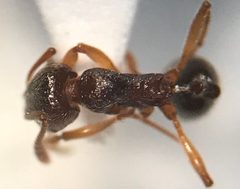
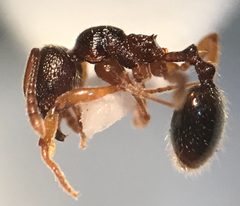
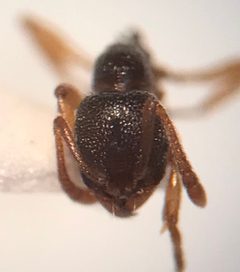
Pronunciation
How to pronounce Stenamma meridionale: /stɛˈnæmə mɛrɪˈdiːəneɪ/
These audio files are automatically generated. While they are not always 100% accurate, they are a good starting point.
Images
Habitat
Based on -level characteristics, Stenamma occupy moderately humid to wet forest . Nesting occurs in diverse microhabitats including leaf litter, large logs, rotting branches, bark, clay or mud banks, epiphytes, rocks, and ground substrates. Some species nest and forage in forest . The genus shows particular abundance in cool, wet cloud forest localities at mid to high elevations (800+ m), where Stenamma can dominate leaf-litter .
Distribution
The specific distribution of Stenamma meridionale is not documented in available sources. The Stenamma occurs throughout the Holarctic region, Central America, and parts of northwestern South America (Colombia and Ecuador).
Ecological Role
Stenamma function as cryptic leaf-litter inhabitants in forest . At mid to high elevations in wet forests, they can become the numerically in leaf-litter , representing an exception to the typical pattern of decreasing ant diversity with elevation. Their small colony size and slow movement suggest they occupy a specialized with reduced competition from more aggressive ant groups.
More Details
Genus-level behavioral traits
Some Stenamma exhibit distinctive nesting , including construction of multiple nests per colony with occupation of only one nest by and , and use of small clay 'door-pebbles' to block nest entrances when encountering aggressive ants such as army ants. These behaviors have been documented in clay-bank nesting species but have not been specifically confirmed for S. meridionale.
Sources and further reading
- BugGuide
- Wikipedia
- GBIF taxonomy match
- iNaturalist taxon
- NCBI Taxonomy
- Catalogue of Life
- Why He Studies Ants | Bug Squad
- President's Prize | Bug Squad
- The peculiar life history of Middle American Stenamma ants | Blog
- Pensoft blog - Part 143
- The Changing Distributions of our Grasshoppers, Crickets and Relatives - Buglife Blog - Buglife