
Aphaenogaster fulva
Roger, 1863
Tawny Collared Ant
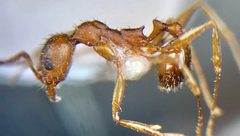
Aphaenogaster fulva is a of myrmicine in the Aphaenogaster, first described by Roger in 1863. It is part of a that has undergone taxonomic revision, with some authorities treating related forms as separate species or . The species has been studied for its spatial distribution patterns in temperate forests, particularly in relation to environmental gradients such as soil moisture and vegetation cover. Like other Aphaenogaster species, it is a ground-nesting ant with foraging habits.

Pronunciation
How to pronounce Aphaenogaster fulva: //əˌfiːnoʊˈɡæstər ˈfʌlvə//
These audio files are automatically generated. While they are not always 100% accurate, they are a good starting point.
Identification
Aphaenogaster fulva belongs to a taxonomically challenging that includes A. rudis and A. texana. Identification to level requires examination of morphological characters that distinguish these closely related forms, including details of mesosomal , petiolar node shape, and coloration patterns. The species typically exhibits tawny or reddish-brown coloration. can be distinguished from some sympatric Aphaenogaster species by the presence of a distinct collar-like structure on the petiole, though this character varies within the complex.
Images
Habitat
Temperate deciduous and mixed forests; nests in soil, often under stones or in rotten wood. In Connecticut, spatial distribution has been documented in relation to forest edges, soil moisture gradients, and vegetation cover patterns.
Distribution
Eastern North America; documented from Connecticut and surrounding regions. The extends across much of the eastern and central United States, though precise range boundaries are complicated by ongoing taxonomic revision.
Diet
omnivore; forages for seeds, small arthropods, and other food resources. Specific dietary components have not been separately documented for this versus other members of the .
Life Cycle
Colony-based social organization with , , and male . and specific developmental timing have not been separately documented for this .
Behavior
Ground-foraging that recruits nestmates to food resources using . Defensive and specific colony-level tactics have not been separately documented from other Aphaenogaster species.
Ecological Role
Soil-dwelling that contributes to nutrient cycling and seed in forest . Specific ecological functions have not been quantified separately from co-occurring ant .
Similar Taxa
- Aphaenogaster rudisMember of the same with overlapping and distribution; distinguished by subtle differences in mesosomal and petiolar node shape
- Aphaenogaster texanaMember of the same ; historically treated as or closely related, with western distribution and minor morphological differences
- Aphaenogaster piceaSympatric congeneric with darker coloration and different nesting preferences, often in more mesic forest conditions
Sources and further reading
- BugGuide
- Wikipedia
- GBIF taxonomy match
- iNaturalist taxon
- NCBI Taxonomy
- Catalogue of Life
- Colony of Red Ants Roams the Bohart Museum of Entomology | Bug Squad
- Hiding Above Our Heads: Rare Ant Species Found in NC Treetops
- Bug Eric: Anteater Scarab Beetles
- How Ants Do Battle: Toxic Sprays, Thick Armor, Overwhelming Numbers, and More
- Seeding for Success - Buglife Blog - Buglife
- Bug Eric: Fungus Party-y-y!
- Spatial Distribution of the Ants Formica subsericea , F. neogagates , and Aphaenogaster fulva (Hymenoptera: Formicidae) in Connecticut