
Pogonomyrmex salinus
Olsen, 1934
Owyhee Harvester Ant
Pogonomyrmex salinus is a native to sagebrush-steppe of the western United States. A 5-year field study in southwestern Idaho documented colony dynamics and vegetation associations, finding inversely related to sagebrush cover and positively associated with non-cheatgrass understory vegetation. The species avoids cheatgrass seeds in its diet, preferring small-seeded grasses and forbs. Colony survival rates improve after the first year, with 12.4% first-year failure compared to 4.6–8.4% in subsequent years.
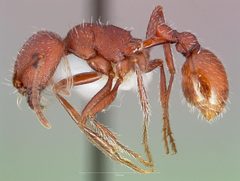
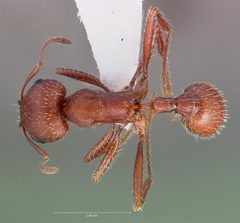
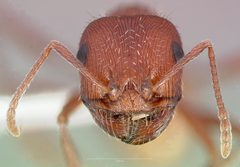
Pronunciation
How to pronounce Pogonomyrmex salinus: //ˌpɒɡənoʊˈmɜːrmɛks səˈlaɪnəs//
These audio files are automatically generated. While they are not always 100% accurate, they are a good starting point.
Images
Habitat
Sagebrush-steppe in southwestern Idaho and adjacent regions. Prefers open areas with exposed ground where vegetation can be cleared from nest vicinities. correlates negatively with sagebrush cover and positively with coverage of non-Bromus (non-cheatgrass) understory vegetation.
Distribution
Western United States, specifically documented from southwestern Idaho. The ' range likely extends through suitable sagebrush-steppe in the region.
Diet
Primarily seeds; specifically avoids cheatgrass (Bromus) seeds while preferring small-seeded grasses and forbs.
Life Cycle
Colony establishment involves nest initiation; first-year colonies experience higher failure rates (12.4%) compared to established colonies (4.6–8.4% failure in years 2–4). Up to 7.1% of colony initiations may represent nest relocations rather than new colonies.
Behavior
Morning patrollers inspect areas up to 20 minutes distance from the nest, signaling the colony to deploy foragers. Foragers may travel up to 20 meters from the colony and spend up to an hour collecting seeds, with approximately 90% return success rate. Constructs large nest disks cleared of vegetation.
Ecological Role
Functions as a seed and agent in sagebrush-steppe . Colony nest rims create 'islands of ' that enhance vegetation growth, particularly during drought and disturbance events. May influence plant composition through selective seed .
Human Relevance
Potential impact on native plant restoration efforts in sagebrush-steppe undergoing conversion to open grasslands. The ' preference for small-seeded native grasses and forbs over cheatgrass may affect seed survival rates in restoration contexts.
Similar Taxa
- Pogonomyrmex occidentalisBoth are western North American harvester ants with similar nest-clearing and sagebrush-steppe associations; P. salinus is distinguished by its specific Owyhee region distribution and documented cheatgrass seed avoidance
- Pogonomyrmex californicusShares and seed-collecting ; differs in geographic distribution (California and desert Southwest vs. Idaho sagebrush-steppe) and specific vegetation associations
More Details
Colony Dynamics
Over a 5-year study period, total colony numbers increased from 843 to 878 (4.15%) across 16 sites, with 315 colony deaths and 350 colony initiations. Spatial distribution was generally random, with only one of 11 analyzed sites showing significant clumping. Final-year ranged from 0.1 to 62.9 colonies per hectare.
Habitat Transition Concerns
The rapid transition from sagebrush-dominated to open grasslands throughout the western United States may negatively impact native plant whose seeds are readily consumed by P. salinus, as the species thrives in open grassland conditions.
Sources and further reading
- BugGuide
- Wikipedia
- GBIF taxonomy match
- iNaturalist taxon
- NCBI Taxonomy
- Catalogue of Life
- Carbo-loading here and there: Odorous house ants, Tapinoma sessile, and harvester ants, Pogonomyrmex — Bug of the Week
- Diptera | Blog - Part 2
- The Painful but Fascinating Stings of Harvester Ants
- Harvester Ant Nest Rims Boost Native, Nonnative Plants Alike
- Harvester Ants Have a Taste for Exotic Seeds
- Heroes, Not Headaches: Reframing the Reputation of Harvester Ants
- Colony dynamics and Plant Community Associations of the Harvester Ant, Pogonomyrmex salinus (Hymenoptera: Formicidae) in Sagebrush-Steppe Habitat