
Temnothorax tricarinatus
(Emery, 1895)
Tricarinatus-group Acorn Ant
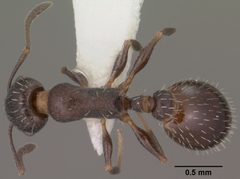
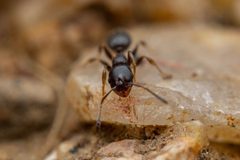
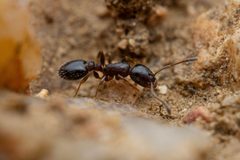
Temnothorax tricarinatus is a of acorn ant in the Formicidae, first described by Emery in 1895. The species belongs to a complex of morphologically similar species within the Temnothorax, commonly referred to as the 'Tricarinatus-group Acorn Ants' on iNaturalist. As with other members of this genus, T. tricarinatus is likely a cavity-nesting species that utilizes small pre-existing spaces such as hollow acorns, twigs, or other plant cavities for colony establishment. The genus Temnothorax comprises over 350 species worldwide, with approximately 60 species known from North America.
Pronunciation
How to pronounce Temnothorax tricarinatus: //tɛm.noʊˈθɔːr.æks traɪˌkær.ɪˈneɪ.təs//
These audio files are automatically generated. While they are not always 100% accurate, they are a good starting point.
Identification
Temnothorax tricarinatus belongs to a that is morphologically difficult to distinguish. The specific epithet 'tricarinatus' (three-keeled) likely refers to a diagnostic sculptural feature on the mesosoma or , though precise diagnostic characters are not readily available in the provided sources. Identification to level within the T. tricarinatus group typically requires examination of fine morphological details such as propodeal spine shape, petiole node proportions, and surface patterns. The species is part of a group that has been historically challenging to resolve using traditional morphological methods alone.
Images
Habitat
Based on -level characteristics and the 'acorn ant' , T. tricarinatus likely inhabits forested or wooded environments where suitable nesting cavities are available. Temnothorax are typically found in leaf litter, under bark, and in dead wood where hollow acorns, twigs, or other small cavities occur. The species has been observed in North America, suggesting temperate forest or woodland .
Distribution
Temnothorax tricarinatus has been documented in North America. The Temnothorax is , with over 350 worldwide. The specific distribution range of T. tricarinatus is not precisely defined in available sources, but as a member of the North American fauna, it likely occurs in temperate regions of the continent.
Host Associations
- Thaumatomyrmex - Specialized ponerine ant known to prey on polyxenid millipedes; while not directly documented for T. tricarinatus, this ecological relationship has been noted for Temnothorax-associated fauna in Neotropical contexts
Behavior
As a member of the Temnothorax, T. tricarinatus likely exhibits typical acorn ant including colony founding in small pre-existing cavities, relatively small colony sizes, and cooperative care. Some Temnothorax are known to be targets of slave-making ants such as Temnothorax pilagens, though specific parasitic relationships for T. tricarinatus are not documented in available sources.
Ecological Role
As with other cavity-nesting ants, T. tricarinatus likely contributes to nutrient cycling in forest through its activities in leaf litter and dead wood. The may serve as prey for specialized and participates in dynamics within its .
Similar Taxa
- Temnothorax curvispinosusAnother North American acorn ant with which T. tricarinatus shares -level characteristics including small body size, cavity-nesting , and morphological similarities that require careful examination to distinguish
- Temnothorax longispinosusClosely related acorn ant with overlapping distribution; distinguished by specific morphological traits including propodeal spine and petiole node characteristics
- Temnothorax pilagensSlave-making in the same that targets related Temnothorax ; T. tricarinatus may be a potential species though this specific relationship is not documented
More Details
Taxonomic Complex
Temnothorax tricarinatus is classified as part of a 'complex' on iNaturalist, indicating that it represents a group of closely related that are difficult to distinguish morphologically. This reflects ongoing taxonomic challenges within the , where cryptic is increasingly being revealed through molecular methods.
Molecular Systematics
The Temnothorax has been subject to recent taxonomic revision using integrated approaches. A 2014 study describing ten new California doubled the known of the genus in that state, demonstrating that even in well-studied regions, Temnothorax diversity has been underestimated. Similar integrated approaches combining and molecular data may be needed to fully resolve the T. tricarinatus complex.
Sources and further reading
- BugGuide
- GBIF taxonomy match
- iNaturalist taxon
- NCBI Taxonomy
- Catalogue of Life
- Pensoft Editorial Team | Blog - Part 131
- Uncategorized | Blog - Part 27
- Novel Genes Determine Different Castes in Ant Colonies
- How One Entomologist is Exploring the Insect Diversity of Prairies
- Bug Eric: Home Bioblitz, Ongoing
- Brazil Bugs #12 – Desafio de identificação #5 | Beetles In The Bush