
Temnothorax rugatulus
(Emery, 1895)
Western Acorn Ant
Temnothorax rugatulus is a small myrmicine native to western North America, notable for its sophisticated collective decision-making and remarkable in size. The species exhibits two distinct queen morphs: large macrogynes associated with single-queen (monogynous) colonies, and smaller microgynes found in multiple-queen (polygynous) colonies. This species has become an important model organism for studying social insect behavior, communication, and the molecular mechanisms underlying determination and phenotypic plasticity.
Pronunciation
How to pronounce Temnothorax rugatulus: /tɛmnoʊˈθɔːræks ruːˈɡætjʊləs/
These audio files are automatically generated. While they are not always 100% accurate, they are a good starting point.
Identification
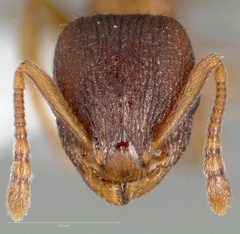
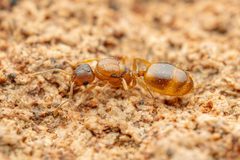
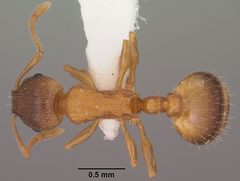
Distinguished from other Temnothorax by the presence of two morphs (macrogynes and microgynes) within , associated with monogynous and polygynous colony structures respectively. are and small. Molecular and behavioral studies often required for definitive species identification within the . The species' western North American distribution and forest help differentiate it from eastern .
Images
Appearance
Habitat
Forests of the western United States, typically nesting in pre-existing cavities such as hollow acorns, twigs, or rock crevices. Colonies are cavity-nesting , utilizing small enclosed spaces with single entrance holes. spans montane and low-elevation forest , with monogynous colonies more common at lower elevations and polygynous colonies at higher elevations.
Distribution
Western North America including: western United States (extending from the Rocky Mountains westward, including North Dakota, South Dakota, and western Texas), Canadian provinces (Saskatchewan, Alberta, British Columbia, Yukon Territories), and northern Mexican states (Baja California, Sonora, Chihuahua).
Life Cycle
Colonies can be either monogynous (single ) or polygynous (multiple queens). Queen morph determines colony structure: macrogynes found in monogynous colonies, microgynes in polygynous colonies. Colony includes both colony fission and independent colony founding. exhibit reproductive plasticity: upon queen loss, workers can develop ovaries and become fertile, particularly in queenless conditions.
Behavior
Exhibits sophisticated collective decision-making using quorum sensing during nest site selection. Scouts evaluate potential nest sites and recruit nestmates through ; colonies prefer sites containing and show preference for darker nest sites. Uses multiple communication methods: tandem running (one-on-one guidance to targets), transportation (physical carrying), and reverse tandem running (guiding ants back to nest from outside locations). Produces context-dependent alarm signals using 2,5-dimethylpyrazine from mandibular glands—this compound attracts nestmates when released near the home nest but causes rejection of potential nest sites when encountered during . Demonstrates division of labor with distinct behavioral during emigrations: primary, secondary, passive, and wandering . Task switching incurs temporal delays. Workers show latitudinal variation in risk : northern colonies forage longer distances with less responsive but more aggressive threat response; southern colonies forage shorter distances with more responsive but less aggressive defense. Navigation relies primarily on visual cues including celestial orientation and landmark memorization; older workers depend more on visual cues while naive workers use trails. Exhibits starvation resistance through brood protection using internal resources, reduced activity, and shorter foraging bouts; size may increase during starvation due to continued brood production.
Ecological Role
Subdominant in forest . Functions as a cavity-nesting that occupies small pre-existing . Serves as prey for specialized including the ponerine ant Thaumatomyrmex. Contributes to nutrient cycling and soil processes through nest construction and foraging activities.
Human Relevance
Important model organism for research on social insect , collective decision-making, communication systems, and the molecular mechanisms of determination and phenotypic plasticity. Studies on this have advanced understanding of quorum sensing, alarm signaling, division of labor, and epigenetic regulation of social traits.
Similar Taxa
- Temnothorax curvispinosusEastern North American with similar cavity-nesting ; distinguished by geographic range and lack of documented size dimorphism
- Temnothorax longispinosusEastern North American used in evolution studies; differs in distribution and morphological patterns
- Temnothorax pilagensSlave-making that raids Temnothorax ; distinguished by specialized predatory and smaller size
More Details
Queen Size Polymorphism and Social Structure
The association between morph and colony structure represents a rare example of intraspecific in social organization. Macrogynes are found in monogynous colonies at lower elevations, while microgynes occur in polygynous colonies at higher elevations. Brain transcriptomes show that the two morphs adjust differently to social environment, with influenced by the interaction between queen morph and social context rather than by either factor independently.
Molecular Mechanisms of Caste and Plasticity
T. rugatulus has been extensively studied for epigenetic regulation of social traits. Histone acetylation regulates and lifespan: removal triggers ovary development and longevity extension in workers, but this is blocked by chemical inhibition of histone acetylation. Small profiles differ between and tissues: piRNAs show age- and caste-independent activity in germline protection, while miRNA expression varies with caste, , and age, suggesting miRNA-mediated regulation of caste-specific gene activity.
Research Methodology Notes
Studies on this have revealed important methodological considerations for behavioral research. Paint marking using CO2 anaesthetization does not affect exploratory and recruitment , validating common marking techniques. However, miniature tracking tag attachment reduces participation in tandem runs without affecting individual activity, demonstrating that tracking devices can negatively impact ant behavior.
Sources and further reading
- BugGuide
- Wikipedia
- GBIF taxonomy match
- iNaturalist taxon
- NCBI Taxonomy
- Catalogue of Life
- Pensoft Editorial Team | Blog - Part 131
- Uncategorized | Blog - Part 27
- Novel Genes Determine Different Castes in Ant Colonies
- How One Entomologist is Exploring the Insect Diversity of Prairies
- Bug Eric: Home Bioblitz, Ongoing
- Brazil Bugs #12 – Desafio de identificação #5 | Beetles In The Bush
- Task switching is associated with temporal delays inTemnothorax rugatulusants
- Assocation of behavioral variation and sucrose sensitivity in Temnothorax rugatulus
- A context-dependent alarm signal in the antTemnothorax rugatulus
- Extraordinary starvation resistance in Temnothorax rugatulus (Hymenoptera, Formicidae) colonies: Demography and adaptive behavior
- Tag attachment reduces the initiation of recruitment in the rock ant, Temnothorax rugatulus
- Histone acetylation regulates the expression of genes involved in worker reproduction and lifespan in the ant Temnothorax rugatulus
- Histone acetylation regulates the expression of genes involved in worker reproduction and lifespan in the ant Temnothorax rugatulus
- Molecular adjustment to a social niche: Brain transcriptomes reveal divergent influence of social environment on the two queen morphs of the ant Temnothorax rugatulus
- Histone acetylation regulates the expression of genes involved in worker reproduction in the ant Temnothorax rugatulus
- Paint marking using CO2 anaesthetization does not affect exploratory and recruitment behaviours in the rock ant, Temnothorax rugatulus
- In-nest behavior by tandem recruiters of the ant Temnothorax rugatulus: effects of context and quality
- Latitudinal variation in behaviors linked to risk tolerance is driven by nest-site competition and spatial distribution in the ant Temnothorax rugatulus
- Division of labour promotes the spread of information in colony emigrations by the ant Temnothorax rugatulus
- The Effect of Brood Quantity on Nest Site Choice in theTemnothorax rugatulus(Hymenoptera: Formicidae)
- Age- and caste-independent piRNAs in the germline and miRNA profiles linked to caste and fecundity in the ant Temnothorax rugatulus
- Molecular Adjustment to a Social Niche: Brain Transcriptomes Reveal Divergent Influence of Social Environment on the Two Queen Morphs of the Ant Temnothorax rugatulus.