
Anergates atratulus
(Schenck, 1852)
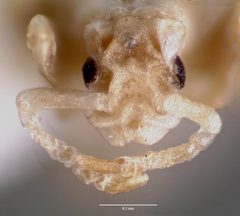
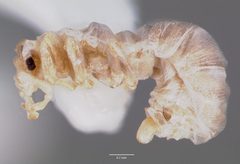
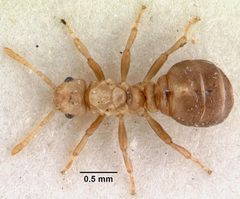
Anergates atratulus is an extreme workerless social () that lives exclusively within colonies of Tetramorium . It is one of the most specialized ant parasites known, lacking a entirely and producing only sexual forms (males and queens). The species is IUCN Red-Listed and considered rare across its European range.
Pronunciation
How to pronounce Anergates atratulus: /ænɜːrɡeɪtiːz əˈtrætjʊləs/
These audio files are automatically generated. While they are not always 100% accurate, they are a good starting point.
Identification
Distinguished from all other European ants by its complete lack of ; colonies consist only of males and queens. Queens are small, dark-colored, and morphologically reduced compared to Tetramorium queens. Males are similarly diminutive. Confusion possible with other workerless in the Tetramorium, but A. atratulus is smaller and more morphologically simplified. Molecular identification (COI gene) may be required for definitive host- association confirmation.
Images
Habitat
Strictly confined to nests of in the Tetramorium, particularly the T. caespitum/imurum complex and T. chefketi . Occupies the same nest chambers as host colonies in various open, dry to mesic where host species occur.
Distribution
Europe: documented from Belgium (Flanders, Flemish Region, Walloon Region), Luxembourg, Czech Republic, Slovakia, Bulgaria, and Turkey. Distribution is patchy and locally restricted, tracking the ranges of . Listed as present globally in GBIF records, though actual occurrence is limited to specific European localities.
Diet
Fed by through ; does not forage independently or possess foraging workers.
Host Associations
- Tetramorium caespitum - typical Primary from caespitum/imurum complex
- Tetramorium impurum - caespitum/imurum complex
- Tetramorium moravicum - unusual Documented in Bulgaria; chefketi
- Tetramorium chefketi - unusual Documented in Bulgaria and Turkey; chefketi
- Tetramorium diomedeum - Documented record
- Tetramorium staerckei - Identified via COI gene and morphometrics
Life Cycle
Workerless lifecycle: queens infiltrate established colonies, are accepted by host , and produce only sexual offspring (males and new queens). No worker is produced. New queens must locate and integrate into new host colonies to continue the cycle. Laboratory observations indicate high mortality during incorporation attempts.
Behavior
Queens exhibit female-female competition for access to males during mating. Incorporation into colonies is hazardous; host of both Tetramorium caespitum and Strongylognathus testaceus have been observed killing A. atratulus in laboratory conditions. Coexists with host (s) within the nest rather than replacing them.
Ecological Role
Social that impacts colony dynamics and resource allocation; reduces host reproductive output by diverting host care to parasite offspring.
Human Relevance
IUCN Red-Listed of conservation concern due to rarity and specialized requirements. Subject of scientific interest as an extreme example of social and loss in ants.
Similar Taxa
- Strongylognathus testaceusAlso a social of Tetramorium, but produces (slave-making dulosis) and is not workerless; behaviorally and ecologically distinct
- Tetramorium inquilinesOther workerless in Tetramorium share and , but A. atratulus is smaller and more morphologically reduced; requires careful morphological or molecular distinction
More Details
Conservation status
Included in the IUCN Red List of threatened ; rarity likely due to extreme specificity and patchy distribution of suitable host colonies.
Laboratory study limitations
Key behavioral observations derive from laboratory conditions with queenless colony fragments; field incorporation success rates and natural mating remain poorly documented.
Sources and further reading
- BugGuide
- GBIF taxonomy match
- NCBI Taxonomy
- Catalogue of Life
- Unusual Ant Hosts of the Socially Parasitic AntAnergates atratulus(Schenck, 1852) (Hymenoptera, Formicidae)
- Laboratory observations on Anergates atratulus (Schenck, 1852): mating behaviour, incorporation into host colonies, and competition with Strongylognathus testaceus (Schenck, 1852)
- New Distribution Record for the Social Parasitic AntAnergates atratulus(Schenck, 1852) (Hymenoptera: Formicidae): An Iucn Red-Listed Species