
Anergates
Forel, 1874
Species Guides
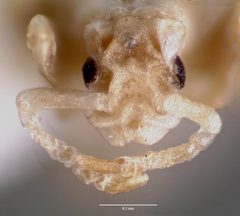
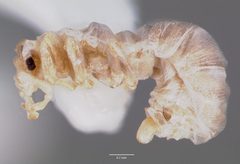
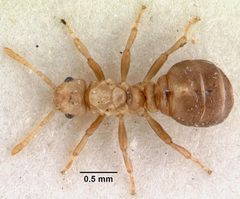
1Anergates is a of myrmicine ants containing the single Anergates atratulus, an extreme workerless social . The species lacks a and depends entirely on colonies of Tetramorium ants for survival and . It is listed on the IUCN Red List of threatened species.
Pronunciation
How to pronounce Anergates: /ænˈɜː.ɡə.tiːz/
These audio files are automatically generated. While they are not always 100% accurate, they are a good starting point.
Identification
Anergates atratulus can be distinguished from its Tetramorium by its reduced associated with workerlessness: smaller size, reduced , and simplified body structure typical of social . and males are the only present.
Images
Habitat
Occurs within nests of in the Tetramorium; specific preferences are those of its hosts.
Distribution
Locally distributed throughout large parts of the ranges of its Tetramorium . New distribution records continue to be documented. Documented from Bulgaria, Turkey, and other regions where host species occur.
Host Associations
- Tetramorium caespitum - Primary ; laboratory incorporation attempts with queenless colonies failed, with killing A. atratulus
- Tetramorium staerckei - Identified as new through integrative morphometric and COI gene analysis
- Tetramorium moravicum - Confirmed in Bulgaria
- Tetramorium chefketi - Confirmed in Bulgaria and Turkey; belongs to T. chefketi rather than typical T. caespitum/imprum complex
- Strongylognathus testaceus - competitorNot a ; laboratory experiments showed killed A. atratulus , indicating competitive or antagonistic interaction
Behavior
exhibit female-female competition for males, a observed in laboratory nests. Incorporation into colonies involves infiltration attempts; however, laboratory observations with queenless colony fragments of Tetramorium caespitum resulted in aggression and gyne mortality.
Ecological Role
Extreme workerless social ; dependent on colony resources for survival and without contributing labor.
Human Relevance
Listed on the IUCN Red List of threatened ; considered rare.
Similar Taxa
- Tetramorium ; Anergates occurs within Tetramorium nests and resembles host in general form but differs in reduced parasitic and absence of
More Details
Taxonomic Note
Anergates was established by Forel in 1874. Some sources list it as a synonym of Tetramorium, but GBIF and other taxonomic databases currently recognize it as an accepted . The Catalogue of Life lists it as a synonym, reflecting ongoing taxonomic debate.
Laboratory vs. Field Behavior
Failed incorporation experiments were conducted with queenless colony fragments only, not established queenright colonies; field may differ. Female-female competition behavior was observed in laboratory nests and may not represent complete natural behavioral repertoire.
Host Range Expansion
Recent studies have expanded known range from the typical Tetramorium caespitum/imprum complex to include the T. chefketi (T. moravicum, T. chefketi), suggesting broader host plasticity than previously recognized.
Sources and further reading
- BugGuide
- GBIF taxonomy match
- NCBI Taxonomy
- Catalogue of Life
- Unusual Ant Hosts of the Socially Parasitic AntAnergates atratulus(Schenck, 1852) (Hymenoptera, Formicidae)
- Laboratory observations on Anergates atratulus (Schenck, 1852): mating behaviour, incorporation into host colonies, and competition with Strongylognathus testaceus (Schenck, 1852)
- New Distribution Record for the Social Parasitic AntAnergates atratulus(Schenck, 1852) (Hymenoptera: Formicidae): An Iucn Red-Listed Species