
Neivamyrmex nigrescens
(Cresson, 1872)
Black Legionary Ant
Neivamyrmex nigrescens is a North American army ant and the most widely distributed in its across the United States. Colonies are nomadic and primarily , conducting raids on other nests to prey on larvae and pupae. The species has been extensively studied due to its broad range, making it one of the best-known Neivamyrmex species. Colony relocation events have been observed during morning hours in cooler seasons, contrasting with strictly nocturnal emigrations in summer.
Pronunciation
How to pronounce Neivamyrmex nigrescens: //ˈneɪ.və.mɪər.ˌmɛks nɪˈɡrɛ.sɛnz//
These audio files are automatically generated. While they are not always 100% accurate, they are a good starting point.
Identification
can be recognized by their nomadic, ground-foraging in coordinated groups. Males are attracted to lights at night and may be distinguished from by their reduced antennal elbow (less pronounced than in workers or many other ants). Queens are conspicuously large and surrounded by worker attendants during colony emigrations. Identification to level requires examination of morphological characters not described in available sources.
Images
Appearance
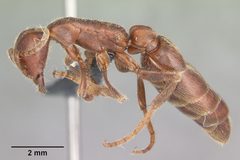
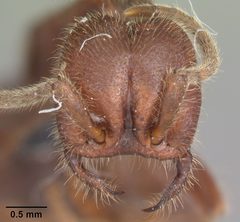
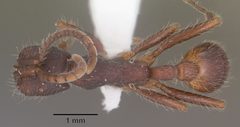
are medium-sized army ants with dark coloration. Queens are considerably larger than workers and conspicuous during colony emigrations. Males possess wings and have been observed flying to lights at night; they lack the distinctly elbowed typical of many , instead showing relatively straight antennae.
Habitat
Documented from desert-grassland and dry-mesic upland oak/pine forest. Associated with open habitats including glades and prairies. Colonies are subterranean and nomadic, without permanent nest structures.
Distribution
United States and Mexico. Most widely distributed Neivamyrmex in the United States. Documented from Colorado, Missouri, and southwestern states.
Seasonality
Active year-round with seasonal shifts in activity patterns. Strictly during summer months. Morning activity and emigrations observed during cooler fall conditions; surface activity ceases when temperatures become reliably cold.
Diet
Specialized of other , raiding nests to prey on larvae and pupae.
Host Associations
- Ulkeus intricatus - myrmecophileClown beetle (Histeridae: Hetaeriinae) found only in association with Neivamyrmex legionary ants; likely a colony guest, though exact nature of relationship (mutualism to kleptoparasitism) unknown
Life Cycle
Colonies undergo periodic fission, with sexual produced and colony division occurring. Colonies are nomadic for approximately two weeks out of every month during warmer months, alternating with stationary periods. Overwinter as sedentary colonies.
Behavior
Nomadic colony lifestyle with regular emigrations. Mass recruitment coordinates group foraging and raiding. Colonies do not immediately emigrate upon food depletion, remaining at feeding sites for extended periods even when food is exhausted. exhibit precocial behavior, requiring stimulation by during mass recruitment. Colony relocation events involve queens heavily attended by worker retinues.
Ecological Role
Human Relevance
Males occasionally enter buildings when attracted to lights at night. Generally not considered a household pest; colonies are subterranean and do not establish permanent nests in structures. Potential agent for pest , though not commonly utilized.
Similar Taxa
- Neivamyrmex opacithoraxCo-occurs in northern range (both found in Missouri); both are strictly in summer and may be seen on cool overcast fall days
More Details
Research significance
Due to its wide distribution, N. nigrescens has become the most studied and well-known in the Neivamyrmex, serving as a model organism for studies of army ant behavioral , mass recruitment, and .
Sources and further reading
- BugGuide
- Wikipedia
- GBIF taxonomy match
- iNaturalist taxon
- NCBI Taxonomy
- Catalogue of Life
- Alydidae | Beetles In The Bush
- Bug Eric: Flying Ants
- 9th Annual Fall Tiger Beetle Trip: Day 1 | Beetles In The Bush
- Bug Eric: A Couple of Weirdos
- Behavioural ecology of mass recruitment in the army ant Neivamyrmex nigrescens
- Behavioral Ecology of the Army Ant Neivamyrmex nigrescens in a Desert-Grassland Habitat
- Army ants do not eat and run: Influence of food supply on emigration behaviour in Neivamyrmex nigrescens
- Precocial behaviour of callow workers of the army ant Neivamyrmex nigrescens: Importance of stimulation by adults during mass recruitment
- The Behavior and Biology of Certain Nearctic Doryline Ants Sexual Broods and Colony Division in Neivamyrmex nigrescens1