
Neivamyrmex harrisii
(Haldeman, 1852)
Harris' Legionary Ant
Neivamyrmex harrisii is a of legionary ant in the Formicidae. Like other members of the Neivamyrmex, it is a nomadic, mostly that raids the nests of other ant species to prey on larvae and pupae. The species is part of a group of ants that includes army ants, characterized by their raiding and lack of permanent nests. Colonies are known to be sedentary during winter months.
Pronunciation
How to pronounce Neivamyrmex harrisii: /ˌneɪvəˈmɜːrˌmɛks ˈhærɪsaɪ/
These audio files are automatically generated. While they are not always 100% accurate, they are a good starting point.
Identification
Neivamyrmex harrisii is one of approximately 120 in the Neivamyrmex, which are distinguished from other ants by their legionary lifestyle: nomadic colonies that conduct raids on other nests. Specific diagnostic features for N. harrisii are not documented in available sources. The genus can be recognized by their and typical of army ant relatives, including reduced in and specialized for prey capture.
Images
Habitat
Specific details for N. harrisii are not documented. Related Neivamyrmex occur in dry-mesic oak/pine forests and similar woodland habitats.
Distribution
The precise geographic range of N. harrisii is not explicitly documented in available sources. The Neivamyrmex occurs from North Carolina and Tennessee to Florida, and west to Texas and Arizona, with additional in the southwestern United States.
Diet
As a legionary ant, Neivamyrmex harrisii preys on the larvae and pupae of other . This specialized predatory is characteristic of the .
Life Cycle
Colonies of Neivamyrmex are nomadic for much of the year, relocating periodically. In warmer months, emigrations occur before dawn for approximately two weeks out of every month. During fall, relocations shift to morning hours when temperatures permit, ceasing entirely when cold weather becomes reliable. Colonies become sedentary over winter.
Behavior
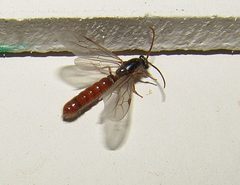
Neivamyrmex harrisii exhibits the legionary ant lifestyle: colonies are nomadic and conduct raids on other nests, primarily at night. are mostly subterranean and , making them rarely observed directly. Colony relocations involve streams of workers accompanying queens. Male (winged reproductives) have been observed flying to lights at night.
Ecological Role
As a of other ants, N. harrisii likely influences structure and in its . It serves as for specialized myrmecophilous beetles, including clown beetles in the Ulkeus ( Histeridae, Hetaeriinae), which are found only in association with Neivamyrmex ants.
Similar Taxa
- Neivamyrmex nigrescensAnother legionary ant in the same , also occurring in the United States. Both share the nomadic, raiding lifestyle and habits. N. nigrescens has been documented in Missouri and Colorado.
More Details
Taxonomic note
The epithet is sometimes rendered as 'harrisi' in some sources, but the original spelling 'harrisii' (Haldeman, 1852) is the accepted form.