
Dolichoderus mariae
Forel, 1885
Mary's Odorous Ant
Dolichoderus mariae is a distinctive North American named after naturalist Mary Treat, who discovered it. The species is notable for its reddish-brown and black bicolored appearance, large polydomous colonies with dozens of nests, and its specialized in prairie and glade where it nests among plant roots. Colonies exhibit dramatic seasonal fluctuations in nest numbers and , and engage in territorial aggression with neighboring colonies.


Pronunciation
How to pronounce Dolichoderus mariae: //ˌdɒlɪˈkɒdərəs ˈmɑːriːeɪ//
These audio files are automatically generated. While they are not always 100% accurate, they are a good starting point.
Identification
The combination of smooth, reflective , bicolored reddish-brown and black coloration, elongated propodeum with concave , and hairless body distinguishes this from other Dolichoderus. In the southern portion of its range, particularly Florida, it can be confused with Dolichoderus pustulatus. The nest architecture—large conical chambers open to air around plant root bases—is diagnostic when observed.
Images
Appearance
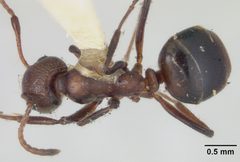
Medium-sized with striking bicolored pattern: , , , legs, petiole, and portion of first abdominal segment are reddish to ochre-brown, while remainder of is black or deep brown. smooth and highly reflective, with fine sculpturing visible under magnification. Propodeum elongated, longer than wide, posteriorly concave with fine vertical striations. Body and head essentially hairless.
Habitat
Prairies, glades, and fens. Nests are constructed underground among fibrous plant roots, specifically under clumps of wiregrass (Aristida stricta), other grasses, blackberry (Rubus spp.), or cattails (Typha spp.). Nest substrate is characteristically dry, sandy soil. The requires vegetation with substantial root systems to serve as nest scaffolding.
Distribution
Eastern and central United States: Illinois, Minnesota, Oklahoma, North Carolina, South Carolina, Georgia, Mississippi, Louisiana, and northern Florida. Type locality: Vineland, New Jersey. Most abundant in the Carolinas; increasingly rare southward where it overlaps with D. pustulatus.
Seasonality
Active year-round with pronounced seasonal colony dynamics. first appear in April, peak in July. occur early morning following heavy rains. Colony nest numbers contract to 1–2 in winter, expand to as many as 60 by late summer, then contract again. Winter nests average 75,000 ; summer nests range 13,000–19,000 workers.
Diet
Obligate association with honeydew-producing Hemiptera: tend and milk aphids and scale insects for honeydew. Also scavenges dead insects. Colony size and nest number correlate positively with hemipteran abundance in territory.
Host Associations
- Rubus spp. (blackberry) - nesting substratefibrous roots provide nest scaffolding
- Typha spp. (cattails) - nesting substratefibrous roots provide nest scaffolding
- Aristida stricta (wiregrass) - nesting substrateprimary nest plant in Florida study
- Aphids - tended for honeydewprimary food source
- Scale insects - tended for honeydewprimary food source
Life Cycle
Complete : , larva, pupa, . Colonies are highly polygynous: 12–59 queens per winter nest, ~180 queens per summer nest. produced seasonally; males disperse to other colonies for mating while females remain at natal nests, presumably mate there, and join existing . , queens, alates, and position themselves on fibrous root scaffolding within nests.
Behavior
Colonies are polydomous, maintaining multiple interconnected nests linked by ground trails. exhibit strong territorial aggression toward adjacent colonies, with colonies occupying roughly the same territory each year. Workers construct papery felt or thatch above some nests during summer by chewing plant material; function unclear. Workers actively excavate soil from beneath plants to create conical chambers.
Ecological Role
engineer: extensive soil excavation modifies root zone structure. Keystone mutualist: tends honeydew-producing Hemiptera, influencing their . Winter nest abandonment creates shelter for vertebrates (snakes, lizards) and (ground-dwelling spiders). Colony size fluctuations may regulate hemipteran populations through tending intensity.
Human Relevance
Named for Mary Treat (1830–1923), pioneering American naturalist and entomologist, honoring her contributions to insect studies. No documented economic importance; not known as household pest or agricultural pest. Scientific interest focuses on its unusual polydomous colony structure and seasonal dynamics.
Similar Taxa
- Dolichoderus pustulatusOverlaps in southern range (Florida); similar requires careful distinction
More Details
Etymology
named by Auguste Forel in 1885 to honor Mary Treat, who discovered the species. Treat was a self-taught naturalist who corresponded with Charles Darwin and published extensively on insect , particularly .
Nest Architecture
Each nest consists of a single large conical chamber open to air around the base of the plant—unusual structure among subterranean ants. Nest size with root system volume of the host plant.
Research History
Most detailed ecological study conducted in northern Florida; prior to this, basic was poorly documented despite being described in 1885.
Sources and further reading
- BugGuide
- Wikipedia
- GBIF taxonomy match
- iNaturalist taxon
- NCBI Taxonomy
- Catalogue of Life
- A Gathering of Entomologists; UC Davis Graduate Students Are Major Important Part | Bug Squad
- Aphaenogaster mariae, male - Entomology Today
- Aphaenogaster mariae, worker - Entomology Today
- Aphaenogaster mariae colony in tree limb - Entomology Today
- Aphaenogaster mariae Archives - Entomology Today
- Aphaenogaster mariae, worker - Entomology Today