
Dolichoderus pustulatus
Mayr, 1886
Bog Odorous Ant
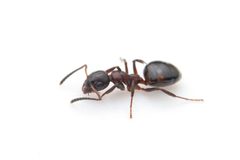
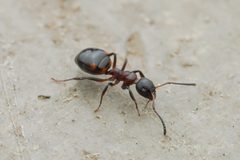
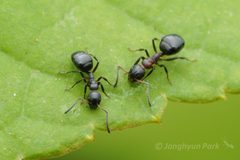
Dolichoderus pustulatus is a North American in the Dolichoderinae. exhibit geographic color variation, with southern showing orangish-brown , , metasoma, and legs with a darker , while northern populations tend toward uniform reddish-brown or dark brown. The species constructs distinctive nests with carton material or under leaf litter in wetland and grassland .
Pronunciation
How to pronounce Dolichoderus pustulatus: //ˌdɒlɪkəʊˈdɪərəs ˌpʌstjʊˈleɪtəs//
These audio files are automatically generated. While they are not always 100% accurate, they are a good starting point.
Identification
Distinguished from Dolichoderus mariae and Dolichoderus taschenbergi by smaller colony size and nest architecture. The shallow punctation on the and propodeum, combined with the smooth reflective and specific propodeal proportions, separate it from similar . Geographic color variation can cause confusion with other brown dolichoderine ants; punctation pattern and propodeal shape provide consistent characters.
Images
Appearance
show clinal color variation: in the southern range, , , metasoma, and legs are orangish-brown with a darker , sometimes with pale spots on the first and second gastral segments; antennae and legs darken with age. Northern are more uniformly reddish-brown to dark brown. The dorsum of the head, metasoma, and propodeum bear shallow puncture marks. The propodeum dorsum is approximately 1.5 times longer than wide. The petiole and gaster have smooth, reflective . Short hairs present near the gaster apex and on legs; body otherwise largely hairless.
Habitat
Occupies fens, prairies, glades, and woodland edges. Nests constructed in soil among plant roots, either hidden under leaf litter or enclosed in thin-walled carton built around grass blades.
Distribution
Eastern North America: Nova Scotia westward to Illinois and Oklahoma, south to Florida and Mississippi. Range lies east of the Rocky Mountains, spanning northern United States and southern Canada.
Behavior
Colonies construct nests using chewed vegetable matter formed into thin carton walls around grass blades, or nest under leaf litter. Nest entrances are short tubular structures of carton material resembling small teapots. Colonies are smaller than those of Dolichoderus mariae and Dolichoderus taschenbergi.
Similar Taxa
- Dolichoderus mariaeLarger colony size; similar but distinguishable by nest characteristics and colony demography
- Dolichoderus taschenbergiLarger colony size; similar but distinguishable by nest characteristics and colony demography
More Details
Nesting architecture
The produces distinctive nest entrances: short tubes of carton material that resemble teapot spouts, built from chewed vegetable matter.
Sources and further reading
- BugGuide
- Wikipedia
- GBIF taxonomy match
- iNaturalist taxon
- NCBI Taxonomy
- Catalogue of Life
- A Gathering of Entomologists; UC Davis Graduate Students Are Major Important Part | Bug Squad
- Dolichoderus quadripiunctatus Archives - Entomology Today
- Burying Beetles Are Part of Nature's Clean-up Crew
- Video Shows U.S. Customs Agents Screening for Invasive Insect Pests