
Gilpinia hercyniae
(Hartig, 1837)
European Spruce Sawfly
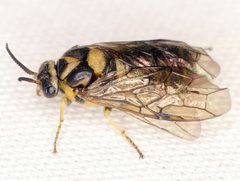
Gilpinia hercyniae, the European spruce , is a defoliating pest of spruce trees native to Europe and introduced to North America. The caused severe in eastern Canada and the northeastern United States during the 1930s, with estimated timber losses of 10 million cubic metres. subsequently declined due to natural viral and introduced agents. The species exhibits arrhenotokous , with males rarely encountered.


Pronunciation
How to pronounce Gilpinia hercyniae: /ɡɪlˈpɪniə hɜrˈsɪni.aɪ/
These audio files are automatically generated. While they are not always 100% accurate, they are a good starting point.
Images
Habitat
Forests and plantations containing spruce (Picea spp.), particularly Sitka spruce (Picea sitchensis) in the United Kingdom and western North America. In Great Britain, highest densities occur in western and northern regions where trees are abundant.
Distribution
Native to Europe (including Britain, Czechoslovakia, Finland, Germany, Romania, and Sweden). Introduced to North America, first detected near Hull, Quebec in 1922; subsequently spread throughout eastern Canada (Quebec, New Brunswick, Newfoundland, Manitoba to Atlantic coast) and northeastern United States. Absent from Ireland despite extensive surveys. Records indicate presence in Belgium.
Seasonality
In Ontario, larvae feed on older needles during June and July; where a second occurs, larvae feed from mid-August through September. emerge in spring following .
Diet
Larvae feed on older needles of spruce (Picea spp.).
Host Associations
- Picea abies - European spruce; native in Europe
- Picea sitchensis - Sitka spruce; primary in United Kingdom and western North America
Life Cycle
One or two per year depending on location. Larvae overwinter in cocoons in the litter layer, pupate in spring, and emerge shortly thereafter. Females lay in slits cut in needles. Full-grown larvae (approximately 20 mm) drop to ground and spin cocoons. Second-generation adults emerge within a month and lay eggs producing larvae that feed from mid-August through September.
Behavior
occurs primarily through ; males are very rare. Females oviposit by cutting slits in spruce needles. levels fluctuate considerably between years, with potential for severe dynamics.
Ecological Role
Defoliator of spruce forests; can cause significant tree mortality and alter forest composition. Serves as for multiple including the chalcidoid Dahlbominus fuscipennis and the tachinid fly Bessa selecta.
Human Relevance
Major forest pest with significant economic impact; caused estimated 10 million cubic metres of spruce timber loss in North America during 1930s . Subject of programs involving introduction of and the masked shrew (Sorex cinereus) in Newfoundland as a cocoon . suppression achieved through combination of natural viral and introduced .
More Details
Biological Control
in North America were brought under control through a combination of a spontaneous viral and introduced . In Newfoundland, the introduction of the masked shrew (Sorex cinereus), an that hunts cocoons, contributed to control efforts.
Parasitoid Interactions
The pupal Dahlbominus fuscipennis locates using volatile compounds from fallen spruce needles, then uses contact from the cocoon surface and prepupal to recognize suitable hosts within cocoons.
Sources and further reading
- BugGuide
- Wikipedia
- GBIF taxonomy match
- iNaturalist taxon
- NCBI Taxonomy
- Gilpinia hercyniae . [Distribution map].
- Distribution of Gilpinia hercyniae (Hymenoptera Diprionidae) Eggs within Sitka Spruce Trees
- The Geographical Distribution of Gilpinia hercyniae Hymenoptera: Diprionidae in the United Kingdom
- BESSA SELECTA (MEIGEN) (DIPTERA: TACHINIDAE) AS A PARASITE OF GILPINIA HERCYNIAE (HARTIG) (HYMENOPTERA: DIPRIONIDAE)
- Zur Nahrungsqualität von Fichtennadeln für forstliche Schadinsekten
- Infochemicals influencing the host foraging behaviour of Dahlbominus fuscipennis, a pupal parasitoid of the European spruce sawfly (Gilpinia hercyniae)