
Paracraspis patelloides
(Trotter, 1910)
Bowl Gall Wasp
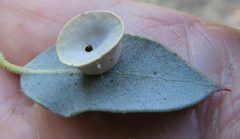
Paracraspis patelloides, commonly known as the Bowl Gall Wasp, is a of cynipid that induces distinctive gall formation on plants. First described by Trotter in 1910 under the Andricus, it was later transferred to Paracraspis. The species is part of the diverse Cynipidae , which contains numerous gall-inducing wasps primarily associated with oaks and related plants. Observations suggest it is moderately well-documented, with over 100 records on iNaturalist.
Pronunciation
How to pronounce Paracraspis patelloides: //ˌpæɹəˈkɹæspɪs ˌpætɛˈlɔɪdiːz//
These audio files are automatically generated. While they are not always 100% accurate, they are a good starting point.
Identification
Distinguished from other gall wasps by the characteristic bowl-shaped galls it induces on plants. The specific epithet "patelloides" (meaning "resembling a small dish or bowl") refers to this gall . are small typical of the Cynipidae , with reduced wing venation and a compact body form. Definitive identification requires examination of gall structure and host association.
Images
Habitat
Associated with oak-dominated and related vegetation where plants occur. Specific microhabitat preferences are not well documented.
Distribution
Distribution details are limited in available sources. Records suggest presence in regions where suitable oaks grow, but precise range boundaries are not established.
Host Associations
- Quercus - gall induction inferred from -level patterns in Cynipidae; specific host not confirmed in available sources
Life Cycle
As with other Cynipidae, development involves gall induction on plant tissue, with larval development occurring within the protective gall structure. Specific details of the for this are not documented.
Ecological Role
Acts as a gall inducer, manipulating plant tissue to create protected feeding and development sites. This interaction represents a form of plant that can influence host plant resource allocation and may provide microhabitats for other organisms.
Human Relevance
No significant documented economic or ecological impact on human activities. Of interest to entomologists and naturalists studying gall wasp diversity and plant-insect interactions.
Similar Taxa
- Other Paracraspis speciesShare -level characteristics and likely similar gall morphologies; distinguished by specific gall shape and associations
- Andricus speciesOriginally described in this and share -level traits; distinguished by gall and taxonomic placement based on morphology
More Details
Taxonomic History
The was originally described as Andricus? patelloides by Trotter in 1910, with the question mark indicating uncertainty in generic placement. It has since been transferred to Paracraspis, reflecting refined understanding of cynipid and .
Observation Record
The has accumulated 111 observations on iNaturalist, suggesting it is not rare but may be undercollected relative to more conspicuous gall wasps.