
Neuroterus saltarius
Weld, 1926
Jumping Gall Wasp
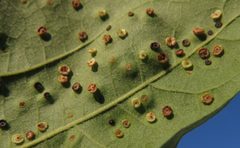
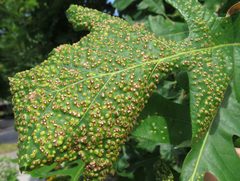
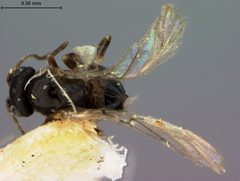
Neuroterus saltarius is a of gall wasp in the Cynipidae, commonly known as the jumping gall wasp. It induces distinctive leaf galls on oak trees that detach from the plant and fall to the ground. The developing larva inside the fallen gall can cause the gall to jump when it moves, a unique behavioral trait that gives the species its . This species is part of the diverse Neuroterus , which contains many oak-associated gall wasps with complex .
Pronunciation
How to pronounce Neuroterus saltarius: /nɛ.ˈɹoʊ.tɛ.ɹəs sɑl.ˈtɛə.ɹi.əs/
These audio files are automatically generated. While they are not always 100% accurate, they are a good starting point.
Identification
Distinguished from other Neuroterus by its jumping gall ; the galls detach from oak leaves and exhibit movement when the larva inside shifts position. The galls themselves are small and typically found on the ground beneath oak trees rather than attached to foliage. Specific morphological features distinguishing it from require microscopic examination.
Images
Habitat
Associated with oak trees (Quercus spp.), particularly in areas where oaks occur. The galls develop on oak leaves but fall to the ground to complete development, indicating a dependency on both arboreal and ground-level microhabitats.
Distribution
Recorded from Canada, specifically British Columbia and Ontario. Distribution likely extends to other regions of North America where suitable oak occur, though precise range boundaries require further documentation.
Life Cycle
Exhibits a complex typical of many Cynipidae, with alternating that may include both sexual and parthenogenetic phases. The jumping gall phase represents one generation where larvae complete development in detached galls on the ground. The full cycle duration and specific timing of generation alternation have not been precisely documented for this .
Behavior
The most notable is the jumping movement of detached galls caused by larval activity inside. This distinguishes it from most other gall wasps where galls remain attached to the plant throughout development. The mechanism and adaptive significance of this jumping behavior remain subjects of investigation.
Ecological Role
As a gall-former, it induces abnormal plant growth that provides food and shelter for its larvae. The detached, jumping galls may represent a or avoidance . Like other cynipid , it likely serves as for wasps, though specific parasitoid associations for N. saltarius are not documented.
Human Relevance
The jumping galls may attract attention from naturalists and observers due to their unusual movement. The contributes to the complex biodiversity of oak-associated insects, which has become increasingly studied for understanding ecological interactions and dynamics.
Similar Taxa
- Neuroterus saltatoriusAlso known as the jumping oak gall wasp; shares the jumping gall and may be confused due to similar and . N. saltarius and N. saltatorius require careful taxonomic distinction.
- Other Neuroterus speciesMany form similar small, spherical leaf galls on oaks, but most do not detach and jump; galls that remain attached to leaves indicate different .