
Neuroterus niger
Gillette, 1888
jumping gall wasp, black jumping gall wasp
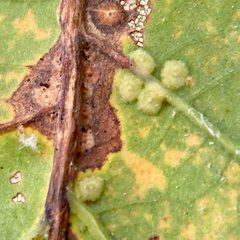
Neuroterus niger is a of gall wasp in the Cynipidae that induces distinctive galls on oak leaves. This species exhibits an alternating sexual and , with different producing different gall types. The asexual generation creates small, spherical galls that detach from leaves and fall to the ground, where the larva's movements cause the gall to jump—giving rise to the "jumping gall." The sexual generation produces inconspicuous leaf galls. The species has been documented across much of eastern and central North America.
Pronunciation
How to pronounce Neuroterus niger: /nʊ.roˈtɛ.rus ˈni.ɡɛr/
These audio files are automatically generated. While they are not always 100% accurate, they are a good starting point.
Identification
The galls of N. niger are small, spherical, and initially green, turning brown as they mature. These galls detach from oak leaves and fall to the ground. The jumping of fallen galls distinguishes this from other oak gall wasps with spherical galls. The sexual generation produces small, inconspicuous galls on leaf . are tiny, typically 1–2 mm in length, with the asexual females being parthenogenetic.
Images
Habitat
Found in oak-dominated forests and woodlands, particularly those with white oak group (Quercus section Quercus) . The galls fall to the leaf litter layer where development completes.
Distribution
Eastern and central North America. recorded from Massachusetts, Michigan, Wisconsin, Iowa, Illinois, Indiana, New York, New Jersey, Pennsylvania, Ohio, Arizona, and Texas in the USA, plus Alberta and Manitoba in Canada. Sexual generation recorded from Illinois, Iowa, Texas in the USA and Alberta in Canada.
Seasonality
galls develop on leaves through summer and mature in late summer to early autumn, falling to the ground where they overwinter. Sexual generation emerges in spring. The full spans approximately two years.
Diet
Larvae feed on nutritive plant tissue induced within the gall. have been observed feeding on sweet secretions produced by cynipid galls.
Host Associations
- Quercus - gall white oak group
Life Cycle
Alternating with complex heterogony. The generation produces spherical leaf galls that fall to the ground; larvae complete development in the gall, which jumps when disturbed by larval movement. Sexual generation produces small, inconspicuous leaf galls. emerge, mate, and females deposit to induce the next generation's galls.
Behavior
The most notable is the jumping of fallen galls caused by larval movement within the gall chamber. This may aid in or avoidance. are poor fliers and move short distances.
Ecological Role
As a gall inducer, N. niger creates microhabitats that support a of and . The nutritive tissue and protective structure of galls provide resources for other organisms. Galls may also influence oak leaf physiology and nutrient cycling.
Human Relevance
Primarily of scientific interest for studying gall induction mechanisms and complex . Not considered a significant pest of oaks. The jumping galls may attract curiosity from naturalists.
Similar Taxa
- Neuroterus saltatoriusAlso produces jumping galls on oaks; distinguished by gall and geographic distribution
- other Neuroterus speciesMany induce spherical oak galls; identification requires examination of gall structure, location on plant, and details
More Details
Molecular confirmation
Alternating previously described under different names were confirmed as through sequencing of cytb and ITS2 markers (GenBank accessions OM 321646–OM 321649 and OM 331835–OM 331838).
Taxonomic history
Originally described as Neuroterus nigrum; the masculine ending niger is now accepted.
Sources and further reading
- BugGuide
- GBIF taxonomy match
- iNaturalist taxon
- NCBI Taxonomy
- Bug of the Week
- Not Just Maize: Africa's Fall Armyworm Crisis Threatens Sorghum, Other Crops, Too
- Eavesdropping on Soybean Weevils: Scientists Detect Subtle Acoustic Signals
- Citizen scientists discover new plant species in the Cape Floral Kingdom | Blog
- How One Entomologist Rears Insects to Support Research and Development
- Meet the Recipients of the 2021 Black in Entomology Student Prizes