
Disholcaspis eldoradensis
(Beutenmuller, 1909)
Honeydew Gall Wasp
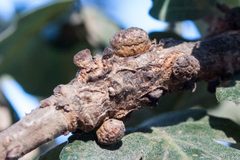
Disholcaspis eldoradensis is a gall wasp in the Cynipidae that induces distinctive galls on valley oak (Quercus lobata). The is notable for producing sucrose-secreting galls that attract mutualists, particularly , which defend the galls against . This mutualism creates a complex trophic involving multiple ant species, parasitoids, and other associated insects. The species exhibits variable ecological outcomes depending on local conditions, with ant defense benefits varying across years and gall characteristics influencing rates.


Pronunciation
How to pronounce Disholcaspis eldoradensis: /dɪˌsɒl.ˈkæs.pɪs ɛlˌdoʊ.rəˈdɛn.sɪs/
These audio files are automatically generated. While they are not always 100% accurate, they are a good starting point.
Identification
Galls produced by D. eldoradensis can be identified by their sucrose-secreting and association with Quercus lobata. The galls are actively tended by ants, which collect honeydew from the gall surface. Gall size and patterns may influence identification, though specific morphological features of the are not detailed in available sources. The can be distinguished from other Disholcaspis species by its plant specificity and gall secretion characteristics.
Images
Habitat
Associated with Quercus lobata (valley oak) in oak-dominated . Specific habitat conditions beyond plant presence are not documented in available sources.
Distribution
Native to western North America, specifically regions where Quercus lobata occurs. The ' range corresponds to that of its plant, which is to California's Central Valley and adjacent foothills.
Host Associations
- Quercus lobata - plantValley oak; sole documented for gall formation
Life Cycle
As a cynipid , D. eldoradensis likely exhibits the characteristic typical of the : a sexual spring producing large, hard galls from which winged of both sexes emerge, and an agamic () generation of wingless females emerging in late autumn or winter. Specific timing and details for this are not documented in available sources.
Behavior
females induce gall formation on Quercus lobata through chemical secretions, likely involving venom compounds as documented in related Disholcaspis . The galls secrete sucrose throughout larval development, attracting mutualists that actively tend the galls and defend against . Ant visitation rates and defensive effectiveness vary temporally and spatially.
Ecological Role
Gall-former that creates and food resources for a complex trophic . The sucrose secretions support mutualists, which in turn alter community composition and reduce rates. The serves as a model for studying facultative mutualisms, multitrophic interactions, and the ecological impacts of ants on native mutualisms. Gall secretions may impose photosynthetic costs on plants.
Similar Taxa
- Disholcaspis quercusmammaBoth are oak-galling Disholcaspis with enlarged venom glands; D. quercusmamma produces rough oak bullet galls on different oak species and lacks the sucrose-secreting characteristic of D. eldoradensis
- Other Disholcaspis speciesMultiple in the induce bullet galls on oaks; D. eldoradensis is distinguished by its specific association with Quercus lobata and its unique sucrose-secreting gall trait
Sources and further reading
- BugGuide
- iNaturalist taxon
- NCBI Taxonomy
- Gall-Inducing Wasps Have Enlarged Venom Glands, Study Finds
- Coccinelidae | Beetles In The Bush
- The Insects Behind the Weird Growths on Plants
- Bug Eric: Wasp Wednesday: Gall Wasps
- Bug Eric: November 2011
- The complex trophic community of Disholcaspis eldoradensis , a sucrose‐secreting cynipid gall wasp of Quercus lobata
- Ant mutualists alter the composition and attack rate of the parasitoid community for the gall wasp Disholcaspis eldoradensis (Cynipidae)