
Callirhytis quercussuttoni
(Bassett, 1881)
Gouty Stem Gall Wasp
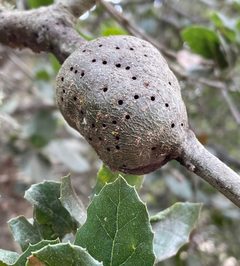
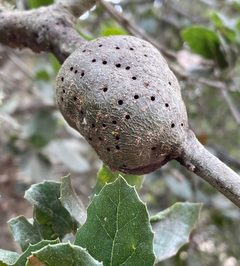
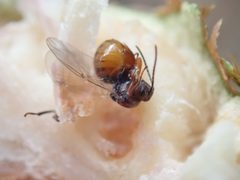
Callirhytis quercussuttoni is a gall wasp in the Cynipidae that induces galls on stems of oaks in the red oak group (section Lobatae). The is restricted to the west coast of North America, where it has been documented on coast live oak (Quercus agrifolia) and interior live oak (Q. wislizeni). Its refers to the swollen, irregular galls it produces on stems.
Pronunciation
How to pronounce Callirhytis quercussuttoni: //kæˈlɪrɨtɪs kwəˌrɛkəˈsʌtoʊni//
These audio files are automatically generated. While they are not always 100% accurate, they are a good starting point.
Identification
Galls induced by C. quercussuttoni appear as woody, irregular swellings on oak stems, often clustered and resembling knobby outgrowths. The galls are hard and persistent, distinguishing them from the spongy oak apples produced by some related . Identification to species level requires examination of gall on specific oaks in the red oak group, combined with geographic location on the Pacific coast.
Images
Habitat
Associated with oak woodlands and forests dominated by red oak group (section Lobatae), particularly in Mediterranean and coastal climates of western North America.
Distribution
West coast of North America. Documented in California on Quercus agrifolia and Q. wislizeni.
Host Associations
- Quercus agrifolia - gall inductioncoast live oak
- Quercus wislizeni - gall inductioninterior live oak
Ecological Role
Gall induction modifies plant tissue, creating specialized for the 's larval development. The hard, woody galls persist on host stems and may serve as microhabitat for other organisms.
Similar Taxa
- Callirhytis quercuspunctataAlso induces gouty stem galls on oaks, but occurs in eastern North America rather than the Pacific coast; range and geographic distribution are primary distinguishing features.
- Callirhytis clavulaProduces galls on oaks, but gall differs—C. clavula galls are not described as succulent or exhibiting latex exudate, unlike some other cynipid galls.
More Details
Taxonomic Note
The specific epithet is sometimes misspelled 'quercussuttoni' versus 'quercussuttoniae' in various sources; Bassett's original description (1881) established the authority.
Host Specificity
The appears restricted to section Lobatae (red oaks), unlike some Callirhytis species that utilize white oaks (section Quercus).