
Burnettweldia washingtonensis
(Gillette, 1894)
fuzzy gall wasp
Burnettweldia washingtonensis is a cynipid gall wasp that induces distinctive stem galls on white oaks (Quercus sect. Quercus) along the Pacific coast of North America. The was originally described as Cynips washingtonensis in 1894 and later transferred to Disholcaspis before its current placement in Burnettweldia. It is locally common and among the more frequently observed oak gall wasps in its range, with over 1,400 citizen science records.
Pronunciation
How to pronounce Burnettweldia washingtonensis: //bɜrˌnɛtˈwɛldiə ˌwɑʃɪŋˈtoʊnɛnsɪs//
These audio files are automatically generated. While they are not always 100% accurate, they are a good starting point.
Identification
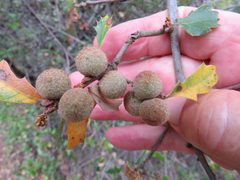
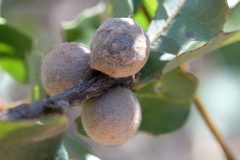
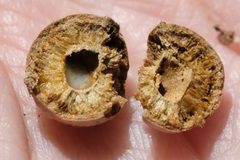
The galls of Burnettweldia washingtonensis are distinguished by their detachable, spherical form with a short stem or neck, gray to beige fuzzy exterior, and 8–10 mm diameter. The interior is chocolate brown with a central larval chamber. Older galls may develop pitted surfaces. These galls are sometimes mistaken for those of Besbicus conspicuus, which induces similar stem galls on oaks.
Images
Habitat
Associated with white oaks (Quercus sect. Quercus) in coastal and near-coastal environments of the Pacific Northwest. The galls form on stems rather than leaves or buds.
Distribution
Pacific coast of North America, from British Columbia south through Washington and Oregon to California.
Host Associations
- Quercus sect. Quercus - white oaks; stem gall inducer
Life Cycle
Larval development occurs within the central chamber of the stem gall. The emerges from the mature gall after completing development. Specific details of voltinism and strategy are not documented.
Ecological Role
As a gall inducer, this modifies plant tissue to create protected larval chambers. The galls serve as microhabitats for a of and . The European parasitoid Bootanomyia dorsalis has been reared from these galls on the Pacific coast, representing an introduced parasitoid association.
Human Relevance
The has contributed to research on oak gall wasp diversity and . Its galls are readily identifiable and have been used in citizen science monitoring through platforms such as iNaturalist and Gallformers.org. The species was included in a 2024 NSF-funded study examining gall wasp-parasitoid across North America.
Similar Taxa
- Besbicus conspicuusInduces morphologically similar stem galls on oaks; galls are sometimes mistaken for those of B. washingtonensis in the field.
More Details
Taxonomic history
Originally described as Cynips washingtonensis Gillette, 1894; later transferred to Disholcaspis; currently classified in Burnettweldia based on morphological and phylogenetic studies of Cynipidae.
Research significance
This has been used as a model for studying introduced impacts. from Oregon to British Columbia yielded genetically uniform introduced parasitoids (Bootanomyia dorsalis), indicating a localized introduction event that subsequently spread across species and regions.