
Atrusca brevipennata
(Gillette, 1893)
little oak-apple gall wasp
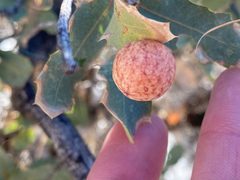
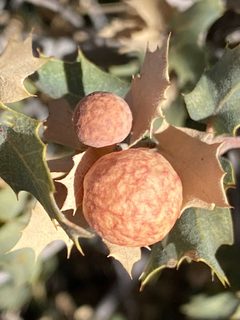
Atrusca brevipennata is a cynipid gall wasp that produces distinctive galls on oak leaves in western North America. Formerly known as Andricus pellucidus, this was first described by Gillette in 1893 and later studied by Alfred Kinsey. The is locally common in the American Southwest, with records extending as far north as Denver. It oviposits into leaves of shrub live oak (Quercus turbinella) and Gambel oak (Q. gambelii), inducing the formation of small oak-apple galls. The species is visually similar to Atrusca bella and may be confused with it in the field.
Pronunciation
How to pronounce Atrusca brevipennata: /əˈtrʌskə ˌbrɛvɪpɛnˈneɪtə/
These audio files are automatically generated. While they are not always 100% accurate, they are a good starting point.
Identification
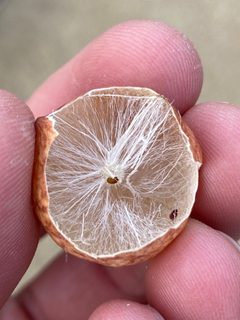
Atrusca brevipennata can be distinguished from the similar Atrusca bella by gall and association. The galls are small oak-apple type structures with the larval chamber positioned centrally, connected to the outer husk by slender, radiating fibers. The itself is tiny and difficult to identify without microscopic examination; gall characteristics and host plant records provide the most reliable field identification cues.
Images
Habitat
Associated with oak woodlands and scrublands in semi-arid regions. Found in supporting shrub live oak and Gambel oak, typically in rocky slopes, canyon bottoms, and foothill zones of the American Southwest.
Distribution
North American Southwest, primarily in Arizona, New Mexico, Utah, Colorado, and adjacent regions. Most commonly observed in the American Southwest with northern records extending to Denver, Colorado.
Host Associations
- Quercus turbinella - plantshrub live oak - primary for oviposition and gall formation
- Quercus gambelii - plantGambel oak - documented for gall induction
Life Cycle
The follows the typical pattern of oak-apple gall wasps. females oviposit into oak leaves using their modified ovipositor. The developing larva secretes plant growth that induce gall formation, creating a protective structure with the larval chamber at the center. The chamber connects to the outer husk via slender, radiating fibers. Larval development occurs within this chamber, followed by . Adults emerge by chewing through the gall wall, leaving a characteristic hole. The specific timing of and whether the exhibits (as seen in some related cynipids) is not documented.
Ecological Role
As a gall-inducer, the functions as a herbivore that manipulates plant tissue development. The galls provide and food for the developing wasp larva, and may serve as microhabitats for other organisms including and . The contributes to local biodiversity of gall-associated in southwestern oak .
Human Relevance
First studied by Alfred Kinsey, who later became famous for his research on human sexuality. Kinsey's early work on cynipid gall wasps established his reputation as a meticulous entomologist before his career shift. The serves as an example of -specific insect-plant relationships and gall induction mechanisms.
Similar Taxa
- Atrusca bellaVisually similar in and gall type; distinguished by subtle differences in gall structure and preferences
- Andricus spp.Formerly classified in this ; related oak-apple gall wasps with similar but distinct associations and gall morphologies