
Andricus quercuspetiolicola
(Bassett, 1863)
Oak Petiole Gall Wasp
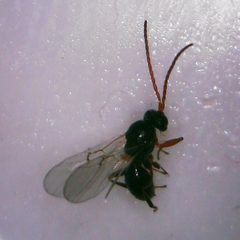
Andricus quercuspetiolicola is a of cynipid gall wasp that induces distinctive galls on white oaks (Quercus alba). The species name reflects its : 'quercus' for oak and 'petiolicola' indicating its habit of forming galls on leaf petioles and midribs. are small and inconspicuous, while the galls they produce are the most visible sign of their presence. Like other Andricus species, this wasp has a complex typically involving alternation between sexual and on different oak tissues, though specific details for this species remain incompletely documented.
Pronunciation
How to pronounce Andricus quercuspetiolicola: //ˈændɹɪkəs ˌkwɛrkəspɛtiˈɑlɪkələ//
These audio files are automatically generated. While they are not always 100% accurate, they are a good starting point.
Identification
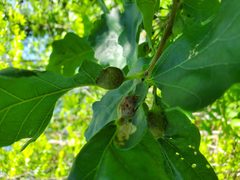
The galls of Andricus quercuspetiolicola form along the midrib or petiole of white oak leaves, distinguishing them from leaf blade galls produced by related . The galls are typically spherical to oval and attach directly to the petiole or midrib rather than the leaf lamina. are minute (2-3 mm), dark-bodied cynipids with reduced wing venation typical of the . The species is best identified by gall location and association rather than adult . Similar Andricus species on white oak can be distinguished by gall position: A. quercusfoliatus forms galls on leaf blades, while A. quercuspetiolicola is restricted to petioles and midribs.
Images
Habitat
Found in deciduous forests and woodlands where white oak (Quercus alba) occurs. The is tied to its tree's distribution, inhabiting dry-mesic to mesic upland forests, slopes, and ravines with mature oak stands. Galls are most readily observed on saplings and lower branches of larger trees where foliage is accessible.
Distribution
Eastern North America, primarily in the range of its white oak (Quercus alba). Documented from the northeastern United States west to the Great Plains and south to the Gulf Coast. Records include Missouri, Illinois, and throughout the Appalachian and oak-hickory forest regions.
Seasonality
and gall initiation occurs in spring when white oak leaves are expanding. Galls develop through summer and mature by late summer to fall. The typically emerges in fall to lay for the next year's cycle, though specific for this is not well documented.
Diet
Larvae feed on nutritive tissue within the gall, which the induces the oak to produce. The gall tissue serves as both food source and protective chamber. do not feed significantly; their mouthparts are adapted for -laying rather than feeding.
Host Associations
- Quercus alba - gall induction on petioles and midribsPrimary and likely sole ; galls form on leaf petioles and midribs
Life Cycle
The involves alternation between a sexual and an (parthenogenetic) generation, typical of Andricus . The sexual generation produces males and females that mate, and females lay that induce galls. The asexual generation produces only females parthenogenetically. Specific details of which generation forms the petiole galls and whether a second gall type is produced on other oak tissues remain unclear for this species.
Behavior
Females use their ovipositor to inject into developing oak leaf petioles or midribs. Larval secretions manipulate plant , redirecting plant growth to form the gall. The larva develops entirely within the gall, pupating in a chamber inside. chew exit holes to emerge. No parental care occurs beyond egg placement.
Ecological Role
As a gall inducer, the functions as a herbivore that manipulates plant resource allocation. Galls may provide microhabitat for and in the gall . Impact on individual tree is generally minimal, though heavy could theoretically affect leaf function. The species contributes to biodiversity of the oak-associated insect community.
Human Relevance
Galls are occasionally noticeable to observers and may prompt curiosity about their origin. No economic significance; the does not damage trees sufficiently to warrant management. Sometimes encountered by botanists and naturalists studying oak galls. The illustrates principles of plant-insect and gall induction mechanisms.
Similar Taxa
- Andricus quercusfoliatusAlso on white oak, but forms galls on leaf blades rather than petioles/midribs
- Andricus quercuscalifornicusSimilar petiole gall former on western oaks; distribution reduces confusion
- Neuroterus speciesOther cynipid gall wasps on white oak, but typically produce different gall morphologies and positions