
Andricus quercusfrondosus
Oak Rosette Gall Wasp
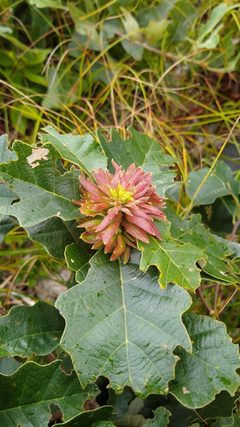
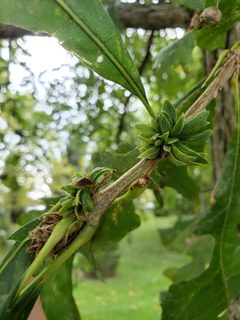
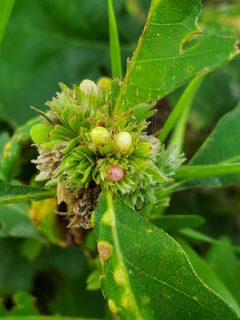
Andricus quercusfrondosus is a cynipid gall wasp that induces distinctive rosette-shaped galls on the leaves of oak trees. As a member of the highly diverse Andricus, this exemplifies the intimate -plant specialization characteristic of gall-forming . The galls provide shelter and food for the developing larva, which manipulates plant growth to create this specialized structure. Like many Cynipidae, this species has a complex often involving alternation between sexual and on different host tissues or related oak species.
Pronunciation
How to pronounce Andricus quercusfrondosus: //ˈandrɪkəs ˌkwɛrkuːsfrɒnˈdəʊsəs//
These audio files are automatically generated. While they are not always 100% accurate, they are a good starting point.
Identification
Distinguished from other Andricus by the rosette of its gall—clustered, overlapping lobes rather than single spherical, bullet-shaped, or crystalline structures. Similar rosette-forming species include Andricus dimorphus, which produces clustered midrib galls on chinquapin oak (Quercus muhlenbergii) specifically along the lower midrib, not scattered across the leaf surface. Andricus pattoni forms smaller, discrete galls on post oak (Quercus stellata). The association with white oaks (Quercus section Quercus) and the particular rosette form are diagnostic.
Images
Habitat
Found in deciduous forests and woodlands where oaks occur. Galls are produced on the leaves of white oak group . The requires mature oak trees with active leaf growth for gall induction.
Distribution
Eastern North America, with records from the northeastern United States southward through the Ozark and Appalachian regions. Documented in Missouri, Illinois, and surrounding states based on oak distribution and iNaturalist observations.
Seasonality
and oviposition occur during spring when oak leaves are expanding. Galls develop through summer and mature by late summer to fall. The exact timing of the sexual , if present, remains undocumented in available sources.
Host Associations
- Quercus alba - gall white oak
- Quercus stellata - gall post oak
- Quercus muhlenbergii - gall chinquapin oak
- Quercus velutina - gall black oak
Life Cycle
The involves a gall-inducing on oak leaves. As with many Andricus , this likely represents an (parthenogenetic) generation; a sexual generation on catkins or other tissues may exist but has not been documented in available sources. Females oviposit into expanding leaf tissue, inducing gall formation. Larvae develop within the gall, pupate in a central chamber, and emerge by chewing an exit hole. The precise alternation pattern and stage are not described in available literature.
Behavior
Females use the ovipositor to inject directly into leaf mesophyll tissue. Larval secretions manipulate plant , redirecting proliferation to form the rosette gall structure. The gall provides physical protection and a specialized nutritive tissue layer for larval feeding.
Ecological Role
As a gall-former, creates microhabitat structure on oak leaves that may be utilized by (other insects that occupy galls without inducing them) and . The galls represent a sink for plant resources, though typically of minor consequence to overall tree health. Contributes to the extraordinary gall diversity associated with oak .
Human Relevance
No direct economic impact. The galls are occasionally noticed by naturalists and gardeners but cause no significant damage to landscape or timber oaks. Serves as an accessible example of plant-insect chemical for educational purposes.
Similar Taxa
- Andricus dimorphusAlso produces clustered galls on oaks, but specifically on the lower midrib of chinquapin oak leaves rather than scattered rosettes on the leaf blade.
- Andricus pattoniForms smaller, discrete galls on post oak leaves, not the elaborate rosette structure.
- Atrusca quercuscentricolaProduces colorful, succulent galls on post oak, but these are single, thickened growths rather than multi-lobed rosettes.
More Details
Gall Biology
The rosette gall represents one of the most structurally complex gall forms in the Cynipidae. The mechanism by which the larva directs this specific —distinct from the spherical, bullet, or crystalline forms induced by —remains unknown. Research on other Andricus suggests co-option of plant developmental programs governing leaf and flower formation.
Taxonomic Note
The specific epithet quercusfrondosus references the oak (quercus) and the leafy (frondosus) appearance of the gall. The was described by Fitch in 1859.