
Aulacidea
Ashmead, 1897
Species Guides
3- Aulacidea acroptilonica(Russian Knapweed Gall Wasp)
- Aulacidea harringtoni
- Aulacidea podagrae
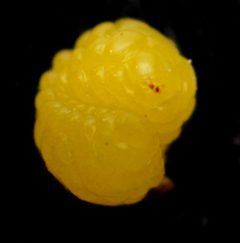
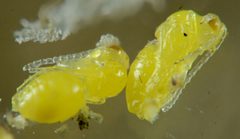
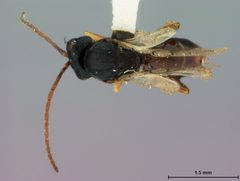
Aulacidea is a of herb gall wasps in the Cynipidae, tribe Aylacini. in this genus induce galls on herbaceous plants, particularly in the Asteraceae and Plantaginaceae families. The genus is considered basal within the cynipid complex and exhibits relatively simple gall developmental patterns compared to more derived cynipid lineages. Aulacidea species support diverse , with some species serving as for multiple parasitoid .
Pronunciation
How to pronounce Aulacidea: /aʊˈlæɪsɪdiə/
These audio files are automatically generated. While they are not always 100% accurate, they are a good starting point.
Identification
Galls induced by Aulacidea are spherical, multichambered, and develop on stems of herbaceous plants. Gall chambers are formed when hatched larvae crawl to separate sites after emerging from laid in sticky clusters. Galls lack the complex anatomical features (elaborate nutritive layers, intricate vascular tissue arrangements) found in cynipid galls on woody plants. are small hymenopterans with typical cynipid ; species-level identification requires examination of morphological characters.
Images
Habitat
Associated with herbaceous plants in open . Known host plants include Hieracium (hawkweed) and Digitalis ferruginea. Galls develop on stems rather than leaves or buds.
Distribution
Recorded from Denmark, Norway, Sweden, Russia (southeast European Russia), and Turkey. Distribution likely broader across the Palearctic region.
Host Associations
- Hieracium umbellatum - plantgall induction on stems
- Hieracium × robustum - plantgall induction on stems
- Digitalis ferruginea - plantfirst record for Aulacidea and possibly Plantaginaceae; gall induction on stems
Life Cycle
Females lay in sticky clusters on plant stems. Eggs cause proliferation of nearby stem tissues. Newly hatched larvae crawl to separate sites where each induces an individual chamber within a common gall structure. Larvae develop within galls in both concealed and exposed positions. occurs within gall chambers. Some have hibernating individuals that undergo obligatory larval .
Behavior
Gall induction involves deposition in clusters followed by larval to chamber-forming sites. This developmental pattern resembles that of cynipids, reflecting the basal phylogenetic position of Aulacidea within Cynipidae.
Ecological Role
Primary gall inducer on herbaceous plants. Supports diverse including specialized and parasitoid . Enables partitioning among parasitoids through differential accessibility of larval and pupal stages in exposed versus concealed gall positions. Serves as for at least ten parasitoid species in some regions.
Similar Taxa
- DiplolepisAlso induces spherical multichambered stem galls, but on woody Rosaceae (Rosa ) rather than herbaceous plants; exhibits more complex gall anatomical development with elaborate nutritive tissue and vascular arrangements
- inquiline cynipidsShares similar gall developmental pattern with larval to separate chambers; Aulacidea is closely related to this basal lineage
More Details
Gall classification
Galls of Aulacidea exemplify 'asterid' type cynipid galls—developmentally and anatomically simple galls on herbaceous plants—contrasted with 'rosid' type galls on woody plants such as roses and oaks.
Parasitoid community
Aulacidea hieracii at least ten in southeast European Russia, including Eupelmus messene (specialized, brachypterous, thelytokous, attacks exposed and concealed larvae and pupae) and Eupelmus microzonus (more , winged, arrhenotokous, attacks concealed larvae and primary parasitoids, lays multiple per host).
Sources and further reading
- BugGuide
- GBIF taxonomy match
- iNaturalist taxon
- NCBI Taxonomy
- Catalogue of Life
- New oviposition behaviour spotted in parasitoid wasp | Blog
- A new species of herb gall wasp (Cynipidae, Aulacideini, Aulacidea) from Turkey
- Eupelmus messene Walker, 1839 and E. microzonus Förster, 1860 as parasitoids of Aulacidea hieracii (Bouché, 1834) (Hymenoptera, Eupelmidae, Cynipidae)
- On the parasitoid community ofAulacidea laurae(Hym., Cynipidae), with description of a new species ofAdontomerus(Hym., Torymidae)
- Figure 1 from: Gokhman VE, Nikelshparg MI (2021) Eupelmus messene Walker, 1839 and E. microzonus Förster, 1860 as parasitoids of Aulacidea hieracii (Bouché, 1834) (Hymenoptera, Eupelmidae, Cynipidae). In: Proshchalykin MYu, Gokhman VE (Eds) Hymenoptera studies through space and time: A collection of papers dedicated to the 75th anniversary of Arkady S. Lelej. Journal of Hymenoptera Research 84: 87-102. https://doi.org/10.3897/jhr.84.68556
- Comparison of the development of stem galls induced byAulacidea hieracii(Hymenoptera: Cynipidae) on hawkweed and byDiplolepis spinosa(Hymenoptera: Cynipidae) on rose
- Figure 2 from: Gokhman VE, Nikelshparg MI (2021) Eupelmus messene Walker, 1839 and E. microzonus Förster, 1860 as parasitoids of Aulacidea hieracii (Bouché, 1834) (Hymenoptera, Eupelmidae, Cynipidae). In: Proshchalykin MYu, Gokhman VE (Eds) Hymenoptera studies through space and time: A collection of papers dedicated to the 75th anniversary of Arkady S. Lelej. Journal of Hymenoptera Research 84: 87-102. https://doi.org/10.3897/jhr.84.68556
- Figure 3 from: Gokhman VE, Nikelshparg MI (2021) Eupelmus messene Walker, 1839 and E. microzonus Förster, 1860 as parasitoids of Aulacidea hieracii (Bouché, 1834) (Hymenoptera, Eupelmidae, Cynipidae). In: Proshchalykin MYu, Gokhman VE (Eds) Hymenoptera studies through space and time: A collection of papers dedicated to the 75th anniversary of Arkady S. Lelej. Journal of Hymenoptera Research 84: 87-102. https://doi.org/10.3897/jhr.84.68556
- Figure 4 from: Gokhman VE, Nikelshparg MI (2021) Eupelmus messene Walker, 1839 and E. microzonus Förster, 1860 as parasitoids of Aulacidea hieracii (Bouché, 1834) (Hymenoptera, Eupelmidae, Cynipidae). In: Proshchalykin MYu, Gokhman VE (Eds) Hymenoptera studies through space and time: A collection of papers dedicated to the 75th anniversary of Arkady S. Lelej. Journal of Hymenoptera Research 84: 87-102. https://doi.org/10.3897/jhr.84.68556