
Philanthus solivagus
Say, 1837
Philanthus solivagus is a of beewolf in the Crabronidae. It is found in North America, with records from Canada including Alberta. As a member of the Philanthus, it shares the characteristic of preying on bees and other hymenopterans to provision nests for its larvae.
Pronunciation
How to pronounce Philanthus solivagus: /fɪˈlænθəs soʊˈlɪvəɡəs/
These audio files are automatically generated. While they are not always 100% accurate, they are a good starting point.
Identification
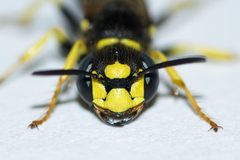
Philanthus solivagus can be distinguished from other beewolf by specific morphological characters, though detailed diagnostic features are not well-documented in available sources. Males lack the tarsal rake (digging spines on front legs) present in females. The Philanthus is characterized by patterns of black and yellow or white coloration, with males typically having all-pale .
Images
Habitat
Based on -level information, Philanthus typically nest in bare, coarse sand, sandy-clay, or sandy loam soils. Females excavate burrows in open, sandy areas with sparse vegetation.
Distribution
North America; specifically recorded from Canada (Alberta) and the United States. The exact southern extent of its range is not clearly documented.
Diet
As a beewolf, females prey on bees and other hymenopterans. The larvae are , feeding on paralyzed prey provided by the female parent. visit flowers for nectar.
Life Cycle
Females excavate burrows 15-24 cm deep (sometimes extending to 1 meter or more), with individual branching from the main tunnel. Each cell is provisioned with multiple paralyzed bees or , and a single is laid on one prey item. The larva consumes the provided prey before pupating. Development time and number of per year are not documented for this .
Behavior
Females actively hunt bees at flowers, stalking and stinging prey between the front legs to paralyze them. Prey is carried beneath the body, held in the middle legs. Males are territorial, perching on vegetation to intercept females and repel competitors. Males scent-mark territory boundaries using abdominal brushes. Some Philanthus exhibit burrow sharing among sibling females and male use of female burrows for shelter, though these are not specifically confirmed for P. solivagus.
Ecological Role
As a of bees and other , P. solivagus helps regulate . It also serves as prey for crab spiders, robber flies, and potentially parasitic satellite flies (Sarcophagidae) and cuckoo wasps (Chrysididae).
Human Relevance
Beewolves are important as . They may contribute to of . No specific economic impact or medical significance has been documented for this .
Similar Taxa
- Philanthus gibbosusMost common North American beewolf; P. solivagus likely distinguished by subtle morphological differences and more northerly distribution
- Philanthus multimaculatusWest coast ; P. solivagus differs in geographic range
- Aphilanthops speciesSimilar Philanthinae that prey on ants rather than bees; distinguished by straight inner margins ( in Philanthus)
- Nomada speciesCuckoo bees that mimic beewolf appearance; distinguished by absence of waist and different wing venation
More Details
Taxonomic Note
Philanthus solivagus was described by Thomas Say in 1837. The specific epithet 'solivagus' (Latin: solus 'alone' + vagus 'wandering') may refer to behavioral or ecological characteristics, though this interpretation is speculative.
Data Limitations
This is poorly documented in the scientific literature compared to better-studied like P. gibbosus and P. triangulum. Most information presented here is inferred from -level studies and may not accurately reflect species-specific traits.