
Philanthus multimaculatus
Cameron, 1891
beewolf, bee-hunting wasp
Philanthus multimaculatus is a common North American beewolf in the Crabronidae. Females are solitary nesters that excavate burrows in sandy soil, often in with conspecifics. They provision nest with paralyzed bees, primarily sweat bees (Halictidae), and lay a single on each prey item. Males exhibit territorial , perching on grass stems near nesting areas to intercept females and chase rival males. visit flowers for nectar and serve as while also functioning as that regulate .
Pronunciation
How to pronounce Philanthus multimaculatus: /fɪˈlænθəs ˌmʌltɪmæˈkjʊlətəs/
These audio files are automatically generated. While they are not always 100% accurate, they are a good starting point.
Identification
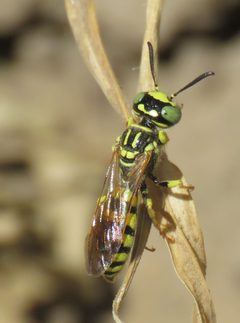
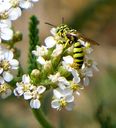
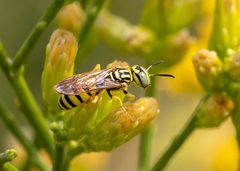
Medium-sized with black and yellow or white patterning typical of the Philanthus. Males have all-pale and lack the tarsal rake (front leg spines used for digging) present in females. Females possess spines on the front legs adapted for excavating soil. The can be distinguished from similar beewolves by geographic range (west coast of North America) and subtle morphological characters.
Images
Habitat
Sandy soil environments including bare, coarse sand, sandy-clay, or sandy loam. Often found in grassland areas where males perch on grass stems. Nesting occurs in where multiple females excavate burrows in close proximity.
Distribution
Western North America from British Columbia and Alberta south to Zacatecas and San Luis Potosi in Mexico. Native to the west coast of the United States.
Seasonality
active in summer; larvae emerge as adults the following summer to continue the cycle.
Diet
feed on nectar from flowers. Larvae are , feeding on paralyzed bees provisioned by the female parent.
Life Cycle
Solitary lifecycle. Females excavate burrows 15–24 cm long with multiple branching from the main tunnel. Each cell is provisioned with several paralyzed bees (primarily Halictidae), then sealed after a single is deposited. Larvae feed on the cached prey and pupate within the cell, emerging as the following summer.
Behavior
Females actively hunt bees at flowers, stalking and stinging victims between the front legs to paralyze them. Prey is transported beneath the body using the middle legs. Males establish landmark territories on grass stems near nesting , defending perches against intruding males to increase mating success. Some nest usurpation and cleptoparasitism has been observed. Males may also spend nights in female burrows.
Ecological Role
of bees, particularly Halictidae, helping regulate . contribute to pollination while foraging for nectar. Potential of conspecifics.
Human Relevance
Important ; agent for . Subject of behavioral research on territoriality and landmark navigation.
Similar Taxa
- Philanthus gibbosusMost common North American beewolf, found continent-wide; P. multimaculatus restricted to western North America
- Philanthus triangulumEuropean beewolf that preys on honeybees; studied by Tinbergen for landmark navigation
- Nomada (cuckoo bees)Often mistaken for beewolves due to similar coloration and -like appearance, but are bees (Apidae) rather than wasps
Sources and further reading
- BugGuide
- Wikipedia
- GBIF taxonomy match
- iNaturalist taxon
- NCBI Taxonomy
- Catalogue of Life
- The Amazing World of 'Gwentomologist' Gwen Erdosh | Bug Squad
- Bug Eric: Wasp Wednesday: Beewolves
- Bug Eric: August 2011
- Bug Eric: June 2012
- Bug Eric: Wasp Wednesday: Ant-queen Kidnappers
- Bug Eric: June 2011
- The Nesting Behavior of Philanthus multimaculatus Cameron (Hymenoptera, Sphecidae)
- Territorial behaviour by males of Philanthus multimaculatus (Hymenoptera: Sphecidae) with a review of territoriality in male sphecids