
Philanthus sanbornii
Cresson, 1865
Sanborn's Beewolf
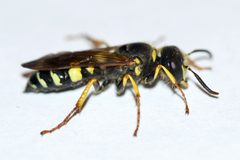
Philanthus sanbornii is a of beewolf in the Crabronidae, native to North America. Unlike many that specialize on bees, this species has been documented as a of flies (Diptera), particularly small muscoid flies. Females construct simple burrows in sandy soil, capture and paralyze prey, and provision nests for their larval offspring. A five-year study in eastern Massachusetts documented over 3,000 prey items from 108 species of bees and wasps, though subsequent research in Florida identified flies as the primary prey. The species exhibits selective prey capture based on temporal availability, spatial distribution, sex ratio, and body size of available prey.
Pronunciation
How to pronounce Philanthus sanbornii: //faɪˈlænθəs sænˈbɔːrni.aɪ//
These audio files are automatically generated. While they are not always 100% accurate, they are a good starting point.
Images
Habitat
Sandy areas with sparse vegetation cover; nests constructed in level sandy soil. In Florida, observed nesting in open sandy . Eastern Massachusetts study site characterized by flower-rich habitats supporting diverse and .
Distribution
North America; recorded from eastern Massachusetts, Florida, and Alberta, Canada. GBIF records indicate presence in North America broadly, with specific records from Canada (Alberta) and the United States.
Seasonality
Active during season coinciding with availability of prey; in Florida, nesting observed during suitable conditions. Eastern Massachusetts study conducted over five years, indicating multi-year activity pattern with year-to-year variation in prey abundance.
Diet
Primarily flies (Diptera), specifically small muscoid flies, based on direct observation of prey capture in Florida. Earlier Massachusetts study documented capture of bees and (108 ), though this may represent opportunistic or regional variation in prey selection. Females paralyze prey with sting and transport to nest.
Life Cycle
Solitary with nest-provisioning . Females construct burrows in sandy soil, capture and paralyze prey, deposit single on provisioned food source. Larvae develop on stored prey. Burrow entrance closed when female is away. Some burrows may reach one meter in length, potentially representing multi-generational expansion.
Behavior
Females construct simple burrows in sandy soil at approximately 45-degree angle, terminating in . Prey captured by stinging to paralyze, then transported held in . Females close burrow entrance when departing and reopen upon return. Exhibit selective prey capture based on prey availability patterns; may return repeatedly to successful hunting sites. Males not involved in nesting.
Ecological Role
of flies and potentially bees and ; may serve as agent for muscoid fly . Prey selection influences local dynamics of and other flower-visiting insects.
Similar Taxa
- Philanthus gibbosusMost common North American beewolf, also in Philanthus, but specializes on bees rather than flies and has distinct behavioral and morphological differences
- Philanthus triangulumEuropean beewolf famous for landmark-based navigation, preys on honeybees, not native to North America
- AphilanthopsRelated in same Philanthinae, also nest in soil and provision with prey, but specialize on queens rather than flies or bees
More Details
Prey Selection Variation
Significant discrepancy exists between prey documented in Massachusetts (108 of bees and ) versus Florida (flies). This may reflect regional dietary variation, temporal shifts in prey availability, or methodological differences in prey identification. The Florida study directly observed prey capture, while the Massachusetts study identified prey from nest remains.
Research History
has been subject of detailed ecological research, including five-year prey analysis documenting temporal and spatial heterogeneity in prey capture. Among seven Philanthus species in eastern North America, P. sanbornii shares common prey size range with but exhibits unique dietary flexibility.
Sources and further reading
- BugGuide
- Wikipedia
- GBIF taxonomy match
- iNaturalist taxon
- NCBI Taxonomy
- Catalogue of Life
- The Amazing World of 'Gwentomologist' Gwen Erdosh | Bug Squad
- Bug Eric: Wasp Wednesday: Beewolves
- Bug Eric: August 2011
- Bug Eric: June 2012
- Bug Eric: Wasp Wednesday: Ant-queen Kidnappers
- Bug Eric: June 2011
- Nesting Behavior of Philanthus sanbornii in Florida (Hymenoptera: Sphecidae)
- Temporal, spatial, sex-ratio and body-size heterogeneity of prey species taken by the beewolf Philanthus sanbornii (Hymenoptera: Sphecidae)