
Philanthus politus
Say, 1824
beewolf
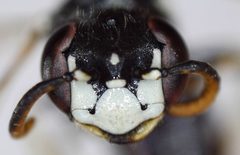
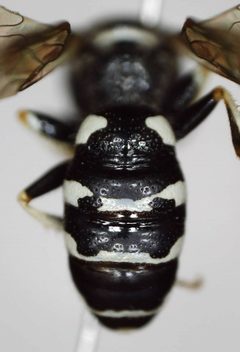
Philanthus politus is a of beewolf in the Crabronidae, characterized by distinctive white striping. As a solitary hunting wasp, females prey on bees to provision underground nests for their larvae. The species is part of the diverse Philanthus, which contains approximately 30 species in North America and about 136 species worldwide.
Pronunciation
How to pronounce Philanthus politus: /fɪˈlænθəs pəˈlaɪtəs/
These audio files are automatically generated. While they are not always 100% accurate, they are a good starting point.
Identification
Distinguished from other beewolf by its white striping. May be confused with cuckoo bees in the Nomada, which are mimics with similar coloration. Separated from Nomada by -like features including a constricted waist and, in females, a tarsal rake on the front legs for digging. Distinguished from other Philanthus species by specific striping pattern, though detailed diagnostic features require closer examination.
Images
Appearance
A white-striped beewolf . Specific body measurements and detailed color patterns beyond the white striping are not documented in available sources. Males have all-pale and lack the tarsal rake (digging spines on front legs) present in females.
Habitat
Open, sandy suitable for nest excavation. Females require bare, coarse sand, sandy-clay, or sandy loam soil for burrow construction.
Distribution
North America; recorded from Canada (Alberta) and the United States. Specific range details beyond these records are limited.
Diet
feed on nectar from flowers. Larvae are , fed paralyzed bees provisioned by the female parent.
Host Associations
- bees (various species) - preyFemales hunt bees as larval food; specific prey records for this are not documented but related Philanthus species take Halictidae, Colletidae, Andrenidae, and other small bees and
Life Cycle
Solitary nesting. Females excavate burrows in sandy soil, create individual , provision them with paralyzed bees, and lay on the prey. Larvae develop within the cells, feeding on the stored bees. Development likely spans one season with emerging in summer, though specific timing for this is not documented.
Behavior
Females actively hunt bees, stalking them at flowers and stinging them between the front legs to paralyze them. Prey is carried beneath the body, held in the middle legs. Males are territorial, perching on low vegetation to intercept females and repel competing males; they scent-mark vegetation with abdominal brushes to establish territory boundaries. Males may roost in female burrows overnight.
Ecological Role
of bees, contributing to regulation of . As a nectar-feeding , may contribute to pollination. Serves as for parasitic satellite flies (Sarcophagidae) and possibly cuckoo wasps (Chrysididae).
Human Relevance
Not considered a significant pest or beneficial for agriculture. Sting is used primarily for prey capture and is not considered medically significant to humans. May be observed by naturalists at flowers or nesting in sandy areas.
Similar Taxa
- Nomada (cuckoo bees)Similar black and white/yellow coloration; Nomada are mimics that can be mistaken for beewolves. Distinguished by bee (branched body hairs, pollen-carrying structures in females) versus waist and lack of branched hairs in Philanthus.
- Philanthus gibbosusAnother common North American beewolf with similar and appearance; P. gibbosus is the most widespread in North America and has been extensively studied. Specific differences in striping pattern and body form separate the two species.
- Aphilanthops (ant-queen kidnappers)Similar appearance and as members of the same Philanthinae; Aphilanthops prey on queens rather than bees and have straight inner margins versus emarginated (notched) margins in Philanthus.
More Details
Taxonomic placement
Crabronidae (formerly placed in Sphecidae), Philanthinae, tribe Philanthini. The subfamily Philanthinae includes beewolves (Philanthus) and ant-queen kidnappers (Aphilanthops), all solitary with specialized prey capture .
Research significance
The European beewolf Philanthus triangulum was a key research subject of Nobel laureate Nikolaas Tinbergen, who coined the term 'beewolf' and demonstrated landmark-based nest location. While P. politus has not been similarly studied, it shares the complex behavioral repertoire characteristic of the .