
Pemphredon inornata
Say, 1824
aphid wasp
Pemphredon inornata is a small solitary in the Crabronidae, commonly known as an aphid wasp. The hunts aphids as prey for its larvae, paralyzing them and transporting them to nest cavities in hollow stems, twig pith, or pre-existing holes in wood. It is one of approximately 20 recognized Pemphredon species in North America north of Mexico. The wasp has been documented exhibiting rapid, evasive that allows it to bypass guards at colonies.
Pronunciation
How to pronounce Pemphredon inornata: //pɛmˈfrɛdən ɪnɔrˈneɪtə//
These audio files are automatically generated. While they are not always 100% accurate, they are a good starting point.
Identification
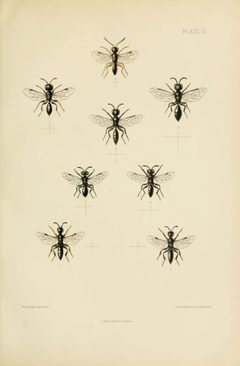
Small, predominantly black typically under 10 mm in length. Body form resembles a miniature thread-waisted wasp with short petiole connecting to . is distinctly cubical (square-shaped) in outline. Wings clear. straight. Lacks the color patterns seen in many other small wasps. Rapid, darting pattern distinguishes it from more hovering wasps at colonies.
Images
Habitat
Found in association with colonies on trees, shrubs, and herbaceous plants. Nests in pre-existing cavities including hollow plant stems, pith of broken twigs or berry canes, and holes in wood. Thorny stems may be preferred as nest sites due to reduced vertebrate herbivory.
Distribution
North America; Europe and Northern Asia (excluding China); Southern Asia. GBIF records confirm presence in North America and Europe.
Seasonality
Most commonly observed in May, then again in August and September, coinciding with peak abundance in spring and fall.
Diet
Host Associations
- Aphididae - preyprimary food source for larvae
Life Cycle
Solitary nesting. Female constructs nest in pre-existing cavity or tunnels through pith. Creates linear series of separated by partitions of chewed plant pith or sawdust. Each cell provisioned with 10 to several dozen prey before deposition. Egg placement variable—at back of cell or midway. Larva consumes stored prey, pupates within cell. Some create branching tunnels in wider twigs rather than linear series.
Behavior
Highly active, rapid makes observation difficult. Female hunts at colonies, plucking prey from stems and leaves with . Can evade guards through speed—ants typically cannot react before exits. Males may wait outside nest tunnels for emerging females to mate. Female sometimes guards nest entrance against and competitors. Small carpenter bees (Ceratina spp.) may destroy Pemphredon nests to usurp cavities.
Ecological Role
of aphids, potentially contributing to . Serves as for cleptoparasitic cuckoo wasps (Omalus spp., Holopyga spp.) that lay in aphid prey; when Pemphredon transports parasitized aphid to nest, cuckoo wasp larva develops instead. Also parasitized by ichneumon wasps (Perithous mediator), bee flies (Anthrax irroratus), and satellite flies (Senotainia trilineata).
Human Relevance
Beneficial as agent for pests. Can be attracted to gardens by providing artificial nesting : blocks of wood with small-diameter holes (2-4 mm) hung under protected eaves. Commercial solitary lodges can be modified for this purpose. Rarely stings; solitary generally sting only if handled.
Similar Taxa
- Philanthus gibbosusbeewolf that preys on bees and including Pemphredon; larger with more robust build, different prey and nesting
- Trypoxylon frigidumspider-hunting crabronid found at same colonies but taking spiders rather than aphids; different prey and nest provisioning
- Ceratina spp.small carpenter bees that compete for same pithy-twig nesting sites; bees have pollen-carrying structures and different
Sources and further reading
- BugGuide
- GBIF taxonomy match
- iNaturalist taxon
- NCBI Taxonomy
- Catalogue of Life
- Meloidae Holdings | Entomology Research Museum
- I am an Entomologist | Beetles In The Bush
- Bug Eric: Aphid Killers: Pemphredon Wasps
- Research Confirms: (Insect) Moms Are the Best
- Bug Eric: Wasp Wednesday: Beewolves
- Bug Eric: "New" Insight Into Behavior of Some Cuckoo Wasps (Chrysididae)