
Hylaeus modestus
Say, 1837
modest masked bee, yellow-faced bee
Species Guides
2- Hylaeus modestus citrinifrons(Modest masked bee)
- Hylaeus modestus modestus(modest masked bee)
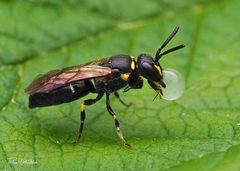
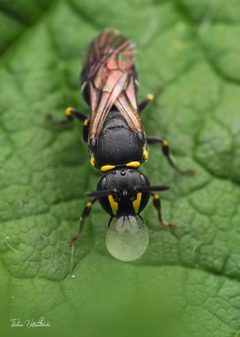
A small, nearly hairless solitary in the Colletidae, native to North America. Females transport pollen and nectar internally in a crop, then regurgitate it into lined with a secreted polymer. The has been observed visiting flowers in garden settings and is a forager. A gynandromorph specimen with bilaterally asymmetric male and female characteristics was documented from Ontario, Canada.
Pronunciation
How to pronounce Hylaeus modestus: /ˈhaɪliəs moʊˈdɛstəs/
These audio files are automatically generated. While they are not always 100% accurate, they are a good starting point.
Identification
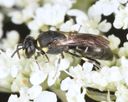
Nearly hairless body with a -like appearance; males have the entire colored yellow or white, while females have yellow, white, or ivory markings only on the inner margin of each . Distinguished from true wasps by (branched) body hairs, though this requires magnification to observe. The combination of sparse , small size, and facial coloration separates it from other Hylaeus , though species-level identification typically requires examination of male genitalia.
Images
Habitat
Nests in pre-existing cavities including hollow stems, twig pith, and abandoned insect burrows. Observed in mixed agricultural settings including beef pasture and crop farms, as well as urban and suburban gardens.
Distribution
North America. Documented from Canada (Ontario) and the United States including Vermont.
Diet
forager. Observed visiting flowers including petunias, begonias, and impatiens in garden settings.
Life Cycle
Females construct individual in pre-existing cavities, lining them with a polymer secretion from abdominal glands. Cells are provisioned with regurgitated nectar and pollen. Larvae have been observed to feed on ethyl ester secretions (ethyl palmitate, ethyl stearate, ethyl eicosanate, and ethyl docosanate) applied to cell walls by , which provides supplementary nutrition for development.
Behavior
Solitary nesting; each female constructs and provisions her own nest without cooperation from other females. apply secretions to walls as larval food supplements. Females transport pollen and nectar internally in a crop rather than on body hairs.
Ecological Role
in agricultural and garden . Documented visiting cultivated flowers, contributing to pollination services in anthropogenic .
Human Relevance
Visited flower cultivars in a two-year Michigan State University study, demonstrating potential value in home gardens for support. Will use artificial nest boxes with small diameter holes or hollow twigs if provided.
Similar Taxa
- Hylaeus basalisSimilar yellow-faced with overlapping North American range; distinguished by specific facial marking patterns and male genitalia structure
- Anacrabro ocellatus frequently mistaken for Hylaeus due to similar small size, black and yellow coloration, and sparse hair; distinguished by wasp's possession of simple unbranched hairs (vs. in bees) and hunting with plant bug prey
Sources and further reading
- BugGuide
- Wikipedia
- GBIF taxonomy match
- iNaturalist taxon
- NCBI Taxonomy
- Catalogue of Life
- Looking for Cheap Urban Real Estate | Bug Squad
- Some Varieties of Annual Flowers Have a Place in Pollinator-Friendly Gardens
- Bug Eric: Wasp Wednesday: Not Wasp VI
- Bug Eric: A Beautiful Place to "Bee"
- Bug Eric: Wasp Wednesday: Anacrabro ocellatus
- National Meadows Day 2022 in Northern Ireland - Buglife Blog - Buglife
- The first gynandromorph record of the North American bee <i>Hylaeus modestus</i> (Hymenoptera: Colletidae)