
Hylaeus basalis
(Smith, 1853)
Cinquefoil Masked Bee
Hylaeus basalis is a solitary in the Colletidae, commonly known as the Cinquefoil Masked Bee. It is native to North America and belongs to the Hylaeus, a group of nearly hairless bees often mistaken for . Like other masked bees, females lack pollen-carrying structures and instead transport nectar and pollen internally in a crop, regurgitating food stores at the nest. The species has been documented in Colorado and Vermont.
Pronunciation
How to pronounce Hylaeus basalis: /hɪˈliːəs bəˈseɪlɪs/
These audio files are automatically generated. While they are not always 100% accurate, they are a good starting point.
Identification
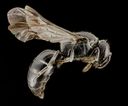
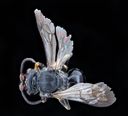
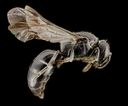
Hylaeus basalis is a relatively large within the Hylaeus. Males can be distinguished from females by their facial markings: males have the entire colored yellow or white, while females have yellow, white, or ivory markings only on the inner margin of each . As with all Hylaeus, the body is nearly hairless, giving a -like appearance. Positive identification to species level from images alone is difficult and typically requires examination by a familiar with native bees.
Images
Habitat
Observed in high-elevation areas, including locations over 8,000 feet in Colorado. The has been documented in montane environments such as Emerald Valley on Cheyenne Mountain. Like other Hylaeus, it likely nests in pre-existing cavities including hollow stems, twigs, or abandoned insect burrows.
Distribution
North America. Documented occurrences include Colorado (Teller County, Cheyenne Mountain area) and Vermont, United States.
Seasonality
have been observed in June and July in Colorado.
Life Cycle
Solitary nesting . Females construct nests in pre-existing cavities such as hollow stems or twigs. Individual are lined with a glandular secretion—a natural polymer that protects stored food from spoilage. Each cell contains a single larva provisioned with regurgitated nectar and pollen.
Behavior
Females forage for nectar and pollen, which they store internally in a crop rather than carrying externally. They nest solitarily, with each female constructing and provisioning her own nest. Males have been observed congregating near nesting areas.
Ecological Role
Likely functions as a , though specific floral associations for this are not well documented. As a member of Hylaeus, it contributes to pollination services in montane where it occurs.
Similar Taxa
- Hylaeus modestusAnother North American Hylaeus ; both are nearly hairless masked bees with similar overall and -like appearance. H. modestus has been documented visiting flowers in garden settings, while H. basalis appears more associated with montane .
- Colletes spp.Plasterer bees in the Colletes share the trait of lining nest with glandular secretions (natural polymers). Both genera include with hairy males that can appear similar in , though Colletes are generally hairier overall and have different facial markings.
More Details
Taxonomic identification
-level identification of Hylaeus from images is challenging due to the subtle morphological differences between species. Expert consultation with taxonomists is typically required for reliable identification.
Sources and further reading
- BugGuide
- Wikipedia
- GBIF taxonomy match
- iNaturalist taxon
- NCBI Taxonomy
- Catalogue of Life
- Looking for Cheap Urban Real Estate | Bug Squad
- Bug Eric: A Beautiful Place to "Bee"
- Bug Eric: Wasp Wednesday: Not Wasp VI
- Biological Control in Brazil is Used on an Area that is Larger than Belgium
- Some Varieties of Annual Flowers Have a Place in Pollinator-Friendly Gardens
- Bug Eric: Wasp Wednesday: Anacrabro ocellatus