
Hylaeus modestus modestus
Say
modest masked bee, yellow-faced bee
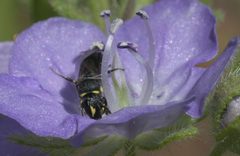
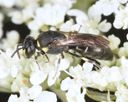
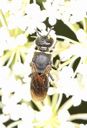
Hylaeus modestus modestus is a of the modest masked bee, a small, nearly hairless solitary in the Colletidae. Like other Hylaeus , it lacks scopal hairs for pollen transport and instead carries nectar and pollen internally in a crop, regurgitating food stores at the nest. The subspecies has been recorded in Canada and the United States, including a notable gynandromorph specimen from Ontario. It is one of approximately 50 Hylaeus species in North America and belongs to the subgenus Prosopis.
Pronunciation
How to pronounce Hylaeus modestus modestus: /hɪˈliːəs moʊˈdɛstəs moʊˈdɛstəs/
These audio files are automatically generated. While they are not always 100% accurate, they are a good starting point.
Identification
Distinguished from by (branched) body hairs visible at 60x magnification or greater; wasps have simple, unbranched hairs. Separated from other by the combination of nearly hairless body, lack of scopal hairs for pollen transport, and facial markings. Within Hylaeus, -level identification requires examination of male genitalia and other subtle morphological features; H. modestus is part of the subgenus Prosopis. May be confused with small sphecid wasps or vespids in the field without close examination.
Images
Appearance
Small, slender with reduced body hair giving a -like appearance. Nearly hairless body with smooth, shiny . Females have yellow, white, or ivory markings on the inner margin of each ; males have the entire colored yellow or white. Lacks the dense scopal hairs on legs seen in most other bees. Requires magnification of 60x or greater to observe (branched) hairs that distinguish it from wasps.
Habitat
Mixed agricultural landscapes including beef pasture and crop farms; urban and suburban gardens with suitable nesting substrates; areas with exposed soil for ground-nesting and hollow stems or twigs for cavity-nesting populations. Nests in pre-existing burrows in soil, cavities in pithy twigs, or abandoned insect galls.
Distribution
North America: recorded from Ontario, Canada (near Kincardine) and the United States including Colorado, Michigan, and other states. The nominate H. m. modestus occurs in the eastern and central portions of the range.
Seasonality
Active during summer months; observed from June through August in northern portions of range. Exact varies with latitude and local climate conditions.
Diet
nectar forager; visits diverse flowering plants including garden flowers such as begonias and impatiens, as well as native wildflowers. Pollen analysis of related Hylaeus indicates preference for Rosaceae when available, otherwise Asteraceae, though specific pollen preferences for this are not documented.
Life Cycle
Solitary; each female constructs and provisions her own nest without cooperation from other females. Nests in pre-existing cavities: hollow stems, twigs, abandoned borings, or soil burrows. lined with glandular secretion (natural polymer/cellophane-like material) applied by female's to prevent spoilage of food stores. Female ingests nectar and pollen, stores in crop, and regurgitates into cells. Larva develops on provisioned food mass.
Behavior
Solitary nesting ; females do not cooperatively provision nests. Males lack stingers and may congregate near female nesting sites, creating the appearance of swarming. Will use artificial nest boxes with bundles of straws, sumac twigs, or drilled wooden blocks. Gynandromorph specimens exhibit bilaterally asymmetric with left/right split of male and female characteristics.
Ecological Role
; contributes to pollination of flowering plants in agricultural and urban environments. Specific services not quantified for this .
Human Relevance
Used in research on attraction to flower cultivars; demonstrated visitation to garden annuals including begonia and impatiens cultivars. Potential for use in urban pollinator conservation through provision of artificial nesting substrates. Gynandromorph specimens of scientific interest for studies of developmental anomalies in bees.
Similar Taxa
- Other Hylaeus speciesNearly identical general appearance; require examination of male genitalia and subtle morphological characters for separation
- Small sphecid wasps (e.g., Crabronidae)Similar -like appearance, size, and coloration; distinguished by branched () hairs visible at magnification and wing venation
- Vespidae (yellowjackets, paper wasps)Similar smooth, shiny, nearly hairless bodies and color patterns; distinguished by branched hairs and lack of -like constricted waist in Hylaeus
Misconceptions
Frequently mistaken for due to nearly hairless, smooth, shiny appearance. The 'yellow-faced bee' refers to facial markings, not to a relationship with the Anthophora or other 'yellow-faced' bees. Some historical records describe Hylaeus as wasps due to superficial similarity.
More Details
Gynandromorphism
The first documented gynandromorph of Hylaeus modestus was recorded from Ontario, Canada in 2023, representing the first record from subgenus Prosopis and the eighth published Hylaeus gynandromorph worldwide. The specimen showed bilaterally asymmetric gynandromorphism with left/right split of female and male characteristics but with male genitalia.
Subspecies taxonomy
Hylaeus modestus includes multiple ; H. m. modestus is the nominate form. The subgenus Prosopis, to which this belongs, has undergone taxonomic revision and may not be monophyletic as currently defined.
Conservation status
Not evaluated for conservation status at the level. Related Hylaeus in Hawaii are critically imperiled due to , but North American different threat profiles.
Sources and further reading
- BugGuide
- Encyrtid Holdings | Entomology Research Museum
- Looking for Cheap Urban Real Estate | Bug Squad
- Some Varieties of Annual Flowers Have a Place in Pollinator-Friendly Gardens
- Bug Eric: Wasp Wednesday: Not Wasp VI
- Bug Eric: A Beautiful Place to "Bee"
- Bug Eric: Wasp Wednesday: Anacrabro ocellatus
- The first gynandromorph record of the North American bee <i>Hylaeus modestus</i> (Hymenoptera: Colletidae)