
Hylaeus communis
Nylander, 1852
Common Masked Bee
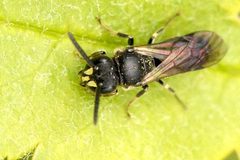
Hylaeus communis is a small, nearly hairless solitary native to the Palearctic region and recently introduced to North America. It is one of the most common and adaptable in its , exhibiting extreme generalism in use and floral visitation. Females transport nectar and pollen internally in a crop, rather than on body hairs, and nest in pre-existing cavities. The species is partially with activity from late May through September.


Pronunciation
How to pronounce Hylaeus communis: /hɪˈliːəs kɒˈmjuːnɪs/
These audio files are automatically generated. While they are not always 100% accurate, they are a good starting point.
Identification
Indistinguishable from other Hylaeus in the field. The is characterized by nearly hairless bodies resembling small , with females showing yellow, white, or ivory markings on the inner margins and males having the entire colored yellow or white. Definitive identification requires microscopic examination of (feather-like) hairs, visible at 60× magnification, or taxonomic analysis.
Images
Habitat
Extremely ; occurs in diverse environments from dry to humid locations. In its native range: forest edges, clearings, field hedges, blackberry thickets, sand/gravel/clay pits, railway embankments, gardens, parks, and areas. From lowlands to subalpine elevations. In its introduced North American range: almost exclusively urban settings.
Distribution
Native across the Palearctic: Portugal through Europe, Asia Minor, the Caucasus to Central Asia; north to Ireland, Scotland, Scandinavia (crossing the Arctic Circle to 67.5°N in Finland), and Russia (Karelia, Kirov); south to Sicily, Crete, Lebanon, and northern Iran. Widespread and abundant in central Europe. Introduced to North America: first recorded in southern Québec, Canada, with potential for continent-wide spread.
Seasonality
Partially . period from mid or late May to September; a partial second flies from early August to September.
Diet
Extremely polylectic. Females have been observed visiting: Allium schoenoprasum, A. sphaerocephalon, A. porrum, A. cepa (Alliaceae); Daucus carota, Aegopodium podagraria (Apiaceae); Cirsium arvense, C. vulgare, Achillea millefolium, A. filipendulina, Tanacetum vulgare, Solidago canadensis, Leontodon autumnalis (Asteraceae); Echium vulgare (Boraginaceae); Sinapis arvensis (Brassicaceae); Campanula rotundifolia (Campanulaceae); Sedum rupestre (Crassulaceae); Galeopsis angustifolia (Lamiaceae); Lythrum salicaria (Lythraceae); Reseda lutea, R. luteola (Resedaceae). Males also visit flowers.
Life Cycle
Nests in pre-existing cavities: insect borings in old wood, abandoned digger wasp nests, mortar joints, cracks in plaster, cavities in old window frames, medullary stems and twigs of Rubus, Sambucus, Rosa; abandoned oak galls of Andricus kollari; old reed galls of Lipara lucens. Accepts artificial nesting aids: holes in wood 2–4 mm diameter (preferably 3 mm), reed stalks. lined with glandular secretion (natural polymer).
Behavior
Solitary; each female constructs and provisions her own nest. Females ingest nectar and store it in a crop, then regurgitate to provision .
Ecological Role
. In its introduced range, shows strong association with non-native plants and may facilitate weed and horticultural plant distribution.
Human Relevance
Recently introduced in North America with potential for widespread establishment. Readily uses artificial nesting aids. in native range, common in gardens and residential areas.
Similar Taxa
- Hylaeus deceptoriusFrequently confused in southern parts of native range; historical records conflated until separation by Benoist (1959)
- Hylaeus hyalinatusAnother established in North America; H. communis is described as more and adaptable
- Hylaeus modestusNorth American native masked ; similar and but distinct distribution
Sources and further reading
- BugGuide
- Wikipedia
- GBIF taxonomy match
- iNaturalist taxon
- NCBI Taxonomy
- Catalogue of Life
- Looking for Cheap Urban Real Estate | Bug Squad
- Bug Eric: Wasp Wednesday: Not Wasp VI
- Bug Eric: A Beautiful Place to "Bee"
- Some Varieties of Annual Flowers Have a Place in Pollinator-Friendly Gardens
- Bug Eric: Wasp Wednesday: Anacrabro ocellatus
- National Meadows Day 2022 in Northern Ireland - Buglife Blog - Buglife
- Hylaeus communis(Hymenoptera: Colletidae), a new exotic bee for North America with generalist foraging and habitat preferences