
Ptiloglossa
Smith, 1853
Species Guides
2- Ptiloglossa arizonensis
- Ptiloglossa mexicana(Mexican feather-tongue)
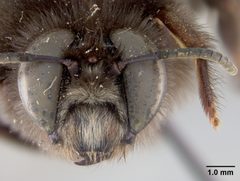
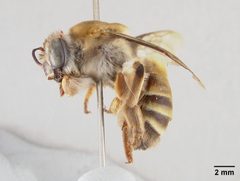
Ptiloglossa is a of large, hairy bees in the Colletidae, to the Americas. The genus is notable for being among the most common colletid bees, with activity restricted to very low light conditions. possess enlarged ocelli that facilitate in dim light. The genus contains approximately 55 species, with highest diversity in South and Central America.

Pronunciation
How to pronounce Ptiloglossa: //ˌtaɪ.loʊˈɡlɒs.sə//
These audio files are automatically generated. While they are not always 100% accurate, they are a good starting point.
Identification
Large, hairy bees with conspicuously enlarged ocelli relative to other colletids. Temporal activity pattern ( or matinal) is a key distinguishing feature. Distinguished from other Caupolicanini and colletid by the combination of large body size, dense pilosity, and /crepuscular .
Images
Distribution
to the Americas. Highest occurs in South America and Central America, with over 50 . Three species extend into the Southwestern United States: Ptiloglossa arizonensis, P. jonesi, and P. mexicana.
Diet
feed on nectar. Larvae are provisioned with liquid food sources sealed within membranous linings; yeasts present in the liquid may serve as the primary protein source for larval development.
Life Cycle
are laid in with liquid larval provisions. Provisions are sealed inside a cellophane-like, membranous cell lining characteristic of colletid bees. Larval development occurs within these sealed cells.
Behavior
Temporally specialized . Activity occurs at sundown (vespertine) or more commonly at pre-dawn (matinal). Employs buzz pollination (sonication) to extract pollen from flowers. activity is restricted to periods of very low light levels.
Ecological Role
and , providing pollination services during periods when most other bees are inactive. Buzz pollination suggests specialization on plants with poricidal anthers.
Similar Taxa
- Other Colletidae generaPtiloglossa is distinguished by its large size, dense hair, enlarged ocelli, and strict / activity; most other colletids are .
- Other nocturnal bees (e.g., some Megalopta, Xylocopa)Shared activity, but Ptiloglossa is distinguished by -level traits including the membranous lining and liquid larval provisions.