
Gonatopus
Olmi, 1984
hump-backed pincer wasps
Species Guides
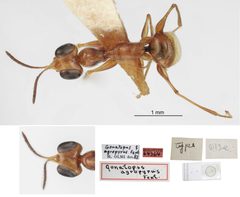
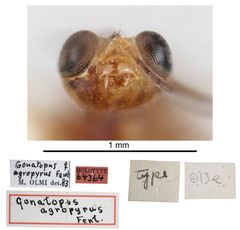
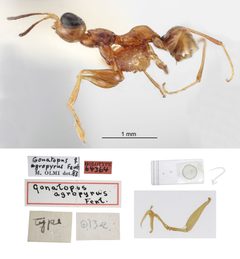
1Gonatopus is a of solitary in the Dryinidae, commonly known as hump-backed pincer wasps. Females are wingless and possess enlarged, scissor-like foretarsi used to capture leafhopper . The genus comprises ectoparasitoid that develop on Auchenorrhyncha, primarily leafhoppers (Cicadellidae) and planthoppers (Delphacidae). Multiple species have been documented as agents of agricultural pests, particularly rice plant hoppers in Asia and the glassy-winged sharpshooter in the Americas.
Pronunciation
How to pronounce Gonatopus: /ɡoʊˈnætəpəs/
These audio files are automatically generated. While they are not always 100% accurate, they are a good starting point.
Identification
Distinguished from other Dryinidae by the combination of wingless females with chelate foretarsi and hump-backed thoracic profile. Differs from Anteon by the more robust body form and distinct thoracic hump. Separated from Dryinus by the wingless female condition and foretarsal structure. -level identification requires examination of male genitalia, foretarsal claw structure, and antennal segment proportions.
Images
Habitat
Diverse terrestrial including tropical and subtropical forests, agricultural (rice paddies, citrus groves, vineyards), and riparian vegetation. occur in and understory strata where leafhopper are abundant.
Distribution
Pantropical and warm temperate distribution. Documented from South America (Brazil, Argentina), Central America, North America (USA), Asia (China, Japan, Vietnam, Taiwan), and Africa. Several have been introduced for outside native ranges.
Seasonality
Activity patterns correspond to availability; multiple per year in tropical regions. Peak abundance typically coincides with leafhopper cycles in agricultural systems.
Host Associations
- Cicadellidae - primary Leafhoppers are principal ; females capture nymphs or with modified foretarsi
- Delphacidae - primary Planthoppers including rice pests Nilaparvata lugens, Sogatella furcifera, Sogatella vibix
- Cicadellidae: Proconiini - Sharpshooters including Homalodisca vitripennis, Tapajosa rubromarginata
- Cicadellidae: Deltocephalinae - Frequenamia documented as for G. amazonicus
- Cicadellidae: Stirellus capitatus - confirmed confirmed for G. viet
Life Cycle
Females capture leafhoppers using enlarged foretarsi and deposit on or within the host body. Larvae develop as ectoparasitoids, consuming the host from the outside or after partial insertion. occurs within a silken cocoon, often attached to vegetation. Development time from egg to varies by temperature and host ; G. amazonicus female emerged 46 days after pupation in one documented case.
Behavior
Females are active hunters, using modified foretarsi to grasp and hold leafhopper . Host capture involves rapid pursuit and seizing with the pincer-like forelegs. Males are winged and likely engage in aerial mate location. Females may exhibit host guarding during larval development.
Ecological Role
regulating of Auchenorrhyncha in natural and agricultural . Significant agents for pest leafhoppers and planthoppers, particularly in rice agroecosystems and vineyards. linked to ; inverse density-dependent has been observed.
Human Relevance
Important agents for agricultural pests. Multiple evaluated or released for control of glassy-winged sharpshooter (Homalodisca vitripennis) in California, rice plant hoppers in Asia, and other economically significant leafhoppers. Research focus on specificity, mass rearing, and augmentative release strategies.
Similar Taxa
- AnteonSimilar dryinid with wingless females, but Anteon females have less robust body form, lack pronounced thoracic hump, and have differently structured foretarsi without the distinctive scissor-like pincer apparatus of Gonatopus.
- DryinusDryinidae with chelate foretarsi, but females are winged (not ) and body form is more slender without the hump-backed thoracic profile characteristic of Gonatopus.
- AphelopusRelated gonatopodine with wingless females, but foretarsi are less dramatically enlarged and body shape differs; associations overlap but morphological distinction clear in thoracic structure.
More Details
Taxonomic history
Gonatopus was established by Olmi in 1984 for previously placed in other dryinid based on the unique combination of wingless females with chelate foretarsi and hump-backed . The genus has undergone significant revision with numerous new species described from the Neotropics and Asia in the 2000s-2010s.
Molecular systematics
using COI sequences has been applied to identification and association confirmation, as demonstrated for G. viet where molecular data confirmed Stirellus capitatus as host. Genetic studies reveal significant intraspecific variation in some lineages.
Collection methods
Females are typically collected by sweeping vegetation in plant associations or using pitfall traps in agricultural systems. Males are attracted to light or captured by . Host-associated collection involves rearing from parasitized leafhoppers showing characteristic cysts of accumulated shed .
Sources and further reading
- BugGuide
- Wikipedia
- iNaturalist taxon
- NCBI Taxonomy
- Catalogue of Life
- Gonatopus victoriensis Olmi foretarsus | Entomology Research Museum
- Primary Type List | Entomology Research Museum
- Publications | Entomology Research Museum
- Gonatopus SPP. Parasitoids on rice plant hoppers
- Figures 2–5 from: Martins AL, Krinski D (2016) First record of the parasitoid Gonatopus flavipes Olmi, 1984 (Hymenoptera, Dryinidae) in Brazil’s Amazon forest. Journal of Hymenoptera Research 50: 191-196. https://doi.org/10.3897/JHR.50.8897
- Redescription and biology of Gonatopus amazonicus Olmi (Hymenoptera, Dryinidae) from Southern Brazil
- First record of the parasitoid Gonatopus flavipes Olmi, 1984 (Hymenoptera, Dryinidae) in Brazil’s Amazon forest
- Application of DNA barcoding confirms the host of Gonatopus viet Olmi, 1986 (Hymenoptera, Dryinidae)
- First Description of the Males of Gonatopus lucens (Olmi) and G. asiaticus (Olmi), with Host Records from Japan (Hymenoptera: Dryinidae: Gonatopodinae)
- Figure 2 from: Chen H-Y, Olmi M, Pang H, Liu J-X (2020) Application of DNA barcoding confirms the host of Gonatopus viet Olmi, 1986 (Hymenoptera, Dryinidae). ZooKeys 944: 115-120. https://doi.org/10.3897/zookeys.944.53054
- Figure 1 from: Chen H-Y, Olmi M, Pang H, Liu J-X (2020) Application of DNA barcoding confirms the host of Gonatopus viet Olmi, 1986 (Hymenoptera, Dryinidae). ZooKeys 944: 115-120. https://doi.org/10.3897/zookeys.944.53054
- Figure 1 from: Martins AL, Krinski D (2016) First record of the parasitoid Gonatopus flavipes Olmi, 1984 (Hymenoptera, Dryinidae) in Brazil’s Amazon forest. Journal of Hymenoptera Research 50: 191-196. https://doi.org/10.3897/JHR.50.8897
- New record of the rare Gonatopus mariae Martins, Lara, Perioto & Olmi, 2015 (Hymenoptera, Dryinidae) for the state of Espírito Santo, Brazil
- New record of Gonatopus flavoniger Olmi, 1991 (Hymenoptera: Dryinidae) from Paraná, Brazil, with notes on some aspects of its biology and morphology