
Sclerodermus
Latreille, 1809
Flat wasp
Species Guides
2Sclerodermus is a of small in the Bethylidae, comprising at least 20 described . These wasps exhibit quasi-social rare among parasitoids: multiple females cooperate to paralyze and provision shared with extended maternal care. Most individuals are wingless, leading to frequent misidentification as ants. The genus is notable for extremely female-biased sex ratios (often 86-97% female) and has significant value as agents against wood-boring beetles, particularly in forestry systems.
Pronunciation
How to pronounce Sclerodermus: /sklɛɹoʊˈdɜrməs/
These audio files are automatically generated. While they are not always 100% accurate, they are a good starting point.
Identification
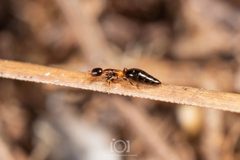
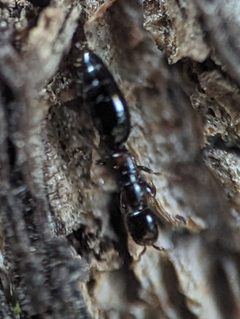
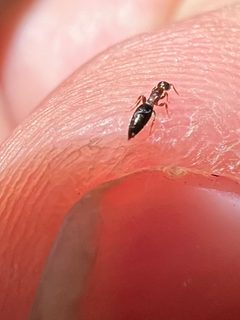
Small measuring 1.5–6 millimeters in length. Most individuals are wingless, resembling ants to the untrained . When wings are present, they are reduced. occurs in antennal structure: females possess trichodea subtype 2, sensilla basiconica subtype 1, and sensilla styloconica subtype 1, while males possess sensilla basiconica subtypes 2 and 3 and sensilla styloconica subtype 2. Males have longer than females in some .
Images
Habitat
Associated with wood-boring , particularly pine forests and timber. Occurs in leaf litter and decaying wood where develop. Some have been documented infesting human residences when wood-boring beetles are present in structural timber.
Distribution
occurs across multiple continents including North America, Europe, and Asia. Documented include: S. macrogaster (southeastern United States), S. carolinensis and S. ventura (United States and Canada), S. domesticus (Europe, particularly Italy), S. cereicollis (Europe), S. harmandi (Japan and China), S. guani (China), S. alternatusi (Yunnan Province, China), and S. pupariae (distribution not specified in sources).
Diet
feed on haemolymph. Larvae develop as ectoparasitoids on paralyzed hosts, feeding through lacunae created by maternal females in host .
Host Associations
- Monochamus alternatus - PARASITOID_OFJapanese pine sawyer ; primary for multiple Sclerodermus including S. harmandi and S. alternatusi. of pine wood Bursaphelenchus xylophilus.
- Aromia bungii - PARASITOID_OFFruit and ornamental tree pest in Rosaceae ; for S. guani.
- Calymmaderus pupatus - PARASITOID_OFPtinid ; for Sclerodermus sp. in Rica.
- Corcyra cephalonica - PARASITOID_OFLaboratory used in experimental studies.
Life Cycle
Females lay on or near paralyzed . Developmental stages include egg, larva, pupa (within cocoon), and . Males typically emerge 1-2 days before females. In S. harmandi, maternal care improves survival of eggs and larvae but not cocoons. Wing is environmentally influenced: temperature between 20–30°C, low light intensity, short-day , and wingless maternal morphs increase production of winged female progeny in S. pupariae.
Behavior
Exhibits quasi-social or sub-social unique among : multiple females cooperate to paralyze and care for shared . Maternal care includes paralyzing hosts with venom, cleaning host surfaces, antennal patting of , repositioning displaced eggs, creating feeding lacunae in host for larvae, dispersing overlapping larvae to reduce competition, and removing dead or melanotic larvae. Females respond to cuticular hydrocarbon cues from offspring, with mature larvae and pupae eliciting prolonged care. Multiparous stepmothers can substitute for biological mothers in providing care; nulliparous stepmothers do not exhibit guarding. Males chew holes in female cocoons to facilitate emergence and mate with emerged females.
Ecological Role
Important agents against wood-boring beetles. S. harmandi has demonstrated 98% reduction in pine -caused tree mortality in field tests by controlling . Acts as natural enemy of beetles that vector plant . Some exhibit hyperparasitism and aggressive interactions with competing .
Human Relevance
Documented to infest human residences, particularly when wood-boring beetles are present in structural timber. S. macrogaster represents first confirmed case of home in North America (Florida, 2017). Multiple stinging incidents reported: S. domesticus in Italy, S. macrogaster in Florida, and Sclerodermus sp. causing dermatitis among school students in Rica. Stings occur when are disturbed in domestic settings. Valued as agents in forestry, with commercial applications against pine sawyer beetles and other wood-boring pests.
Similar Taxa
- Goniozus legneriBoth are bethylid , but Sclerodermus exhibits quasi-social cooperation while G. legneri is typically solitary and aggressive; S. cereicollis has been observed engaging in hyperparasitism against G. legneri without eliciting hostility.
- Ants (Formicidae)Wingless Sclerodermus females are frequently mistaken for ants due to similar size and wingless condition; distinguished by body plan, lifestyle, and absence of petiole nodes characteristic of ants.
Sources and further reading
- BugGuide
- Wikipedia
- GBIF taxonomy match
- iNaturalist taxon
- NCBI Taxonomy
- Catalogue of Life
- Sclerodermus macrogaster - Entomology Today
- Sclerodermus macrogaster on finger - Entomology Today
- Sclerodermus macrogaster Archives - Entomology Today
- Curious Wasp Specimen Leads Entomologist to Find a First
- Olfactory cues in the host-location of the European ecto-parasitoids Sclerodermus cereicollis and Sclerodermus domesticus (Hymenoptera: Bethylidae)
- Maternal Care in the Parasitoid Sclerodermus harmandi (Hymenoptera: Bethylidae)
- Antennal Sensilla in the Parasitoid Sclerodermus sp. (Hymenoptera: Bethylidae)
- Transcriptomic Responses of Sclerodermus alternatusi Yang to Ultraviolet (UV) Stress of Different Wavelengths
- Host adaptation of a gregarious parasitoid Sclerodermus harmandi in artificial rearing
- Host-Size Mediated Trade-Off in a Parasitoid Sclerodermus harmandi
- Behavior and Extra-Oral Digestion of the Wasp Sclerodermus guani (Hymenoptera: Bethylidae) Parasitizing
- CRISPR/Cas9-mediated germline mutagenesis in the subsocial parasitoid wasp, Sclerodermus guani
- Exploring the Biology of Quasi-Social Idiobiont Parasitoids in the Genus Sclerodermus (Hymenoptera: Bethylidae)
- Underlying Chemical Communication in Maternal Care of a Sub-social Parasitoid Sclerodermus guani
- Effect of sublethal dose imidacloprid treatment of Aromia bungii on its parasitoid, Sclerodermus guani
- Effects of biotic and abiotic factors on phenotypic partitioning of wing morphology and development in Sclerodermus pupariae (Hymenoptera: Bethylidae)
- Hyperparasitic showdown: <i>Sclerodermus cereicollis</i>, a non-aggressive but surprisingly secondary hyperparasitoid
- Un brote de dermatitis producido por picaduras de Sclerodermus sp. (Hymenoptera, Bethylidae) en Costa Rica, América Central
- Antennal chemoreceptors in the European ectoparasitoid Sclerodermus cereicollis (Hymenoptera: Bethylidae)
- Effects of Different Sugar Types on Longevity, Fecundity, and Nutrient Metabolism in Sclerodermus guani Xiao et Wu (Hymenoptera: Bethylidae).
- Effects of the Stress of Beauveria bassiana on the Reproductive Success of an Idiobiont Parasitoid, Sclerodermus guani.
- Comparing the Developmental Biology and Brood Size of Four Sclerodermus Species (Hymenoptera: Bethylidae).
- The Thermal Adaptability of Sclerodermus guani Xiao et Wu (Hymenoptera: Bethylidae), an Important Parasitoid of Long-Horned Beetles in China.