
Sclerodermus macrogaster
(Ashmead, 1887)
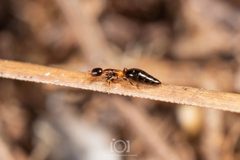
Sclerodermus macrogaster is a small parasitic wasp in the Bethylidae, native to the southeastern United States. The gained attention in 2018 when it was documented for the first time infesting a home in North America, following a report from Florida where a resident was stung. are typically wingless and easily mistaken for ants. The species parasitizes wood-boring beetles, which occasionally leads to co- of structures where such beetles are present.
Pronunciation
How to pronounce Sclerodermus macrogaster: //ˌsklɛroʊˈdɜrməs ˌmækroʊˈɡæstər//
These audio files are automatically generated. While they are not always 100% accurate, they are a good starting point.
Identification
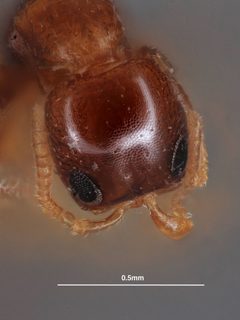
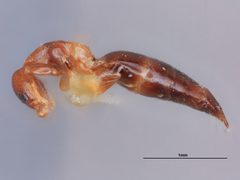
Distinguished from other North American Sclerodermus (S. carolinensis, S. ventura) by morphological characters in the Sclerodermus key of Evans (1978), particularly features of the mesosoma and metasoma. The specific epithet 'macrogaster' refers to enlarged abdominal characteristics. Wingless females require careful examination to separate from ants; presence of a constricted petiole and -like aid recognition. Accurate identification requires comparison with museum specimens and expert keys.
Images
Appearance
Small measuring 1.5 to 6 millimeters in length. are predominantly wingless, with females exhibiting this trait almost exclusively. The wingless condition and small size cause superficial resemblance to ants. is pronounced: males are rare, short-lived, and may possess wings, while females are wingless and can live up to seven months.
Habitat
Naturally occurs in leaf litter and wooded environments where wood-boring beetles are present. Documented in human dwellings when associated with powderpost beetle in structural wood.
Distribution
Native to the southeastern United States. Documented in Florida from the 2018 indoor case. GBIF records indicate presence in Brazil (Amazonas, Espírito Santo, Santa Catarina), though these may represent separate introductions or taxonomic considerations requiring verification.
Diet
of wood-boring beetles; larvae develop on . Specific host associations in North America are not well documented.
Host Associations
- Wood-boring beetles - General -level association; specific for S. macrogaster not definitively established
Life Cycle
Sex ratios in offspring are heavily female-biased (86–97% female). Males emerge, mate, and die within approximately one week. Females may live up to seven months. Development occurs as within larvae or pupae in wood.
Behavior
females are the primary dispersing and foraging stage due to male rarity and short lifespan. Capable of stinging humans when disturbed; the 2018 Florida case documented multiple stings to a resident. Generally associated with leaf litter and away from human habitation under natural conditions.
Ecological Role
agent of wood-boring beetles. Contributes to regulation of in forest and urban . Serves as prey for .
Human Relevance
Documented as a household pest in one North American case (Florida, 2018), where was associated with structural wood-boring beetles and resulted in human stings. Potential for indoor infestation appears lower than European S. domesticus, possibly due to differences in building construction, air conditioning use, or -specific traits. Stings are defensive and painful but not considered medically significant beyond local reaction.
Similar Taxa
- Sclerodermus domesticusEuropean frequently reported infesting homes and stinging humans in Italy and France; S. macrogaster differs in geographic distribution and apparently lower propensity for indoor , though morphological separation requires expert examination
- Sclerodermus carolinensisNative to eastern North America; distinguished by subtle morphological characters in Evans' key, particularly mesosomal and antennal features
- Sclerodermus venturaNative to western North America; distribution aids field separation, though morphological distinction requires detailed examination
- Ants (Formicidae)Wingless females superficially resemble small ants in size and habitus; distinguished by -like petiole structure, with fewer segments, and absence of metapleural glands
More Details
First North American indoor infestation
The 2018 Florida case represented the first documented instance of S. macrogaster infesting a home in North America north of Mexico, reported by Skvarla in the Journal of Medical Entomology. This contrasts with more frequent reports of S. domesticus in Europe.
Taxonomic history
described by Ashmead in 1887. Identification relies heavily on Howard E. Evans' 1978 monograph 'The Bethylidae of America North of Mexico' and comparison with curated museum specimens.