
Ormyrus rosae
Ashmead, 1885
Ormyrus rosae is a of in the Ormyridae, first described by Ashmead in 1885. The species is known from gall-associated in North America, with records from Colorado, Florida, Kansas, New Jersey, and Ontario. As a member of the Ormyrus, it likely parasitizes gall-forming insects, though specific associations for this species remain poorly documented. The species epithet 'rosae' suggests a historical association with rose-feeding hosts, possibly the gall wasp Diplolepis rosae.
Pronunciation
How to pronounce Ormyrus rosae: /ɔɹˈmaɪɹəs ˈɹoʊziː/
These audio files are automatically generated. While they are not always 100% accurate, they are a good starting point.
Identification
Ormyrus rosae can be distinguished from other Ormyrus by subtle morphological characters, likely involving antennal segmentation, mesosomal proportions, and wing venation patterns. The species name 'rosae' may indicate association with rose galls, potentially distinguishing it from oak-associated . However, detailed diagnostic features are not readily available in published sources. Genetic analysis would be required for definitive identification given the cryptic species complexity documented in related Ormyrus species.
Images
Appearance
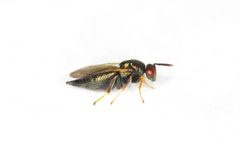
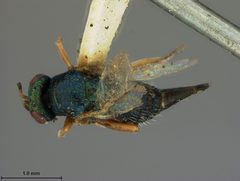
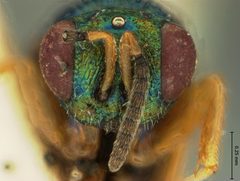
Ormyrus rosae is a tiny chalcidoid , typical of the Ormyridae. Members of this family are generally small, compact wasps with reduced wing venation. The body is likely dark in coloration, possibly metallic, with the characteristic features of Ormyrus including a distinct pronotum and mesoscutum structure. Specific morphological details distinguishing O. rosae from are not well documented in accessible literature.
Habitat
Associated with plant galls, likely on roses (Rosa ) based on the species epithet. The known distribution records suggest occurrence in temperate North American including deciduous woodlands, suburban gardens, and areas where galls are present.
Distribution
North America: recorded from Colorado, Florida, Kansas, New Jersey (United States), and Ontario (Canada).
Diet
As a , larvae develop within insects, likely gall-forming cynipid . Specific host for O. rosae are not documented in available sources.
Host Associations
- Diplolepis rosae - probable Inferred from epithet; not confirmed
Life Cycle
Typical of : laid in or on , larval development within host body, within host gall or in soil, . Specific details for O. rosae are unknown.
Ecological Role
of gall-forming insects, contributing to regulation of gall wasp . May also serve as hyperparasitoid or be subject to by other ( or secondary parasitoids), though specific interactions are undocumented.
Human Relevance
Potential agent for rose galls, though not commercially utilized. Presence indicates healthy gall-associated insect .
Similar Taxa
- Ormyrus labotusHistorically confused ; O. rosae may have been misidentified as O. labotus or vice versa before genetic studies clarified boundaries
- Other Ormyrus speciesMorphologically similar small ; require detailed examination or genetic analysis for separation
More Details
Taxonomic Uncertainty
The Ormyrus has undergone significant revision following genetic studies revealing extensive cryptic diversity. Ormyrus labotus, once considered a of 65+ , was found to comprise at least 16 genetically distinct species. The status of O. rosae relative to this complex has not been explicitly addressed in recent literature and may warrant re-examination.
Specimen Rarity
Only 6 observations recorded on iNaturalist as of source date, indicating either genuine rarity, under-collection, or identification challenges.