
Dicopomorpha echmepterygis
Mockford, 1997
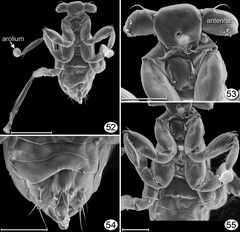
Dicopomorpha echmepterygis is the smallest known insect, with wingless males averaging 186 μm in body length (range 139–240 μm). This mymarid exhibits extreme : males are blind, , and possess relatively long legs, while females are fully winged with functional and black bodies. The is an idiobiont parasitoid of of the lepidopsocid barklouse Echmepteryx hageni. Males complete their entire within the egg, mating with sisters and dying without ever emerging.
Pronunciation
How to pronounce Dicopomorpha echmepterygis: //ˌdɪkəpoʊˈmɔrfə ɛkˌmɛptəˈrɪdʒɪs//
These audio files are automatically generated. While they are not always 100% accurate, they are a good starting point.
Identification
The smallest body size of any known insect (male length under 250 μm) distinguishes this from all others. Males can be identified by their wingless, eyeless condition combined with grayish-brown coloration and relatively long legs. Females are distinguished from other Dicopomorpha species by their entirely black bodies and wing shape. The combination of association with Echmepteryx hageni and the extreme male dwarfism separates this from other mymarids. Microscopic examination required; specimens typically mounted on slides.
Images
Appearance
Extreme . Males: wingless (), eyeless (no ), dull grayish-brown coloration, relatively long legs, small , unsegmented , body length 139–240 μm (average 186 μm for 8 specimens). Females: fully winged with functional wings narrowed slightly through the middle, entirely black bodies, dusky brown legs and antennae, antennae twice as long as males' antennae, body length 550 μm measured for one specimen. and larvae considerably smaller than .
Habitat
Associated with of the lepidopsocid barklouse Echmepteryx hageni, which are laid in concealed locations. The inhabits the microenvironment within eggs. Type locality in Illinois, United States suggests temperate forest or woodland where the host barklouse occurs.
Distribution
Known from Illinois, United States (type locality). Distribution otherwise poorly documented due to minute size and specialized association.
Diet
; larvae develop within and consume of Echmepteryx hageni (Lepidopsocidae, Psocodea). feeding habits unknown.
Host Associations
- Echmepteryx hageni - Idiobiont of . Of five eggs dissected, four contained one male and one female, the fifth contained three males and one female.
Life Cycle
and larvae are considerably smaller than . Development occurs entirely within egg. Adult males mate with sisters inside host egg and die without leaving; females emerge to disperse. Sex ratio appears female-biased based on limited dissection data.
Behavior
Males exhibit extreme philopatry, completing their entire within the natal . Mating occurs between siblings inside the host egg. Males do not disperse or forage outside the host egg. Females emerge from host eggs and presumably disperse to locate new host eggs for oviposition.
Ecological Role
Primary regulating of the barklouse Echmepteryx hageni. As an idiobiont parasitoid, it kills the and prevents host development. Extremely small size allows exploitation of host eggs that may be inaccessible to larger parasitoids.
Human Relevance
No direct economic importance. Serves as an extreme example of miniaturization in insects and evolutionary reduction in males. Of scientific interest for studies on the lower size limits of insect body plans and the evolutionary mechanisms underlying .
Similar Taxa
- Kikiki hunaAlso a mymarid fairyfly and among the smallest known winged insects (155 μm), but Kikiki huna has winged males and females, and lacks the extreme and male aptery of D. echmepterygis.
- Prestwichia aquaticaTrichogrammatid with similar of mating within , but belongs to different and lacks the extreme male dwarfism and aptery of D. echmepterygis.
- Fig wasps (Agaonidae)Exhibit similar with wingless males and mate within fig, but are morphologically distinct / of figs, not parasitoids of barklice.
Misconceptions
The is sometimes cited with body lengths of 130 μm or 139 μm as the absolute minimum; the 139 μm figure represents the smallest measured specimen among 8 males (range 139–240 μm), while 186 μm is the average. The 130 μm figure appears to be an approximation or misreporting. The species is not smaller than all bacteria—Thiomargarita magnifica, a single-celled bacterium, exceeds it in length—but it is smaller than many single-celled including some Paramecium and species.
More Details
Extreme Miniaturization
Males of D. echmepterygis represent the lower known size limit for insects. At 139–240 μm, they are smaller than some single-celled organisms, challenging traditional concepts of multicellular organization. The demonstrates that complex insect body plans can be maintained at sizes approaching cellular dimensions.
Evolutionary Context
The extreme and male reduction in D. echmepterygis represents an evolutionary endpoint of male degeneration found in some chalcidoid wasps. Similar but less extreme patterns occur in other mymarids, trichogrammatids, and fig wasps, suggesting driven by inbreeding within and lack of selection for male .
Taxonomic History
Described by Mockford in 1997 from Illinois, United States. The Dicopomorpha was established by Ogloblin and includes several , with D. echmepterygis representing the most extreme case of miniaturization in the genus.
Sources and further reading
- BugGuide
- Wikipedia
- GBIF taxonomy match
- iNaturalist taxon
- Catalogue of Life
- dicopomorpha_koreana_triapitsyn_berezovskiy_ht_ucrc_ent_23316_body.jpg | Entomology Research Museum
- Primary Type List | Entomology Research Museum
- Publications | Entomology Research Museum
- Ask the Bug Doctor | Bug Squad
- Uncategorized | Blog - Part 38
- Pensoft blog - Part 143