
Metapelma
Westwood, 1835
Species Guides
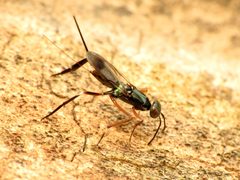
2Metapelma is a of parasitic and the sole genus in the Metapelmatidae. Members are of wood-boring larvae, particularly in families Cerambycidae and Buprestidae. The genus is globally distributed with approximately 40 described . At roughly 6 mm in body length, Metapelma species are notably large compared to other chalcidoid wasps and may be encountered directly in the field rather than solely through rearing.
Pronunciation
How to pronounce Metapelma: /ˌme.təˈpɛl.mə/
These audio files are automatically generated. While they are not always 100% accurate, they are a good starting point.
Identification
Metapelma can be distinguished from other eupelmid by its relatively large size (approximately 6 mm body length) for a chalcidoid . The genus possesses the characteristic eupelmid mesothoracic modification enabling jumping with the middle legs, though this trait is shared with other Eupelminae. Identification to level requires examination of specific morphological characters detailed in taxonomic keys for Oriental and Palaearctic regions.
Images
Habitat
Forest and woodland environments, specifically associated with dead or dying trees containing wood-boring larvae. have been observed on tree trunks with exposed dead wood.
Distribution
Globally distributed. Documented from China (Beijing, Guizhou), India, Kenya, and other regions across the Oriental, Palaearctic, Afrotropical, and other biogeographic realms. Specific distribution varies by .
Host Associations
- Cerambycidae - longhorn beetle larvae; wood-borers
- Buprestidae - including Coraebus cavifrons; wood-boring larvae in tree trunks
Life Cycle
Solitary development; a single larva develops per larva. occurs within the host gallery, typically 5–10 mm beneath the bark in xylem tissue. emerge 5–8 days after pupal collection in observed cases.
Behavior
Solitary habit; exhibits synparasitism (co-occurrence with other such as Spathius ochus on the same individual). may be encountered directly on tree trunks with exposed dead wood, unusual for chalcidoid wasps of this size.
Ecological Role
Natural enemy and potential agent of wood-boring beetles, including pest in ornamental and economically valuable trees. May help regulate of Cerambycidae and Buprestidae in forest .
Human Relevance
Potential for use in of agricultural and forest pests, particularly wood-boring beetles that damage timber and ornamental trees. Direct observation possible due to relatively large size compared to other chalcidoids.
Similar Taxa
- EupelmusBoth belong to Eupelmidae; Metapelma distinguished by larger size (~6 mm vs. typically smaller) and association with wood-boring rather than the diverse hosts of Eupelmus including scale insects, , and spider
- SpathiusBoth parasitize wood-boring beetles and may co-occur on same ; Metapelma is solitary while Spathius is typically gregarious, and they belong to different (Eupelmidae vs. Braconidae)
More Details
Taxonomic Note
The placement of Metapelma has been subject to revision. While some sources list Metapelmatidae as a distinct family, others classify Metapelma within Eupelmidae. The Catalogue of Life and NCBI recognize Metapelmatidae as a separate family, while GBIF places the in Eupelmidae.
Fossil Record
The includes one fossil , †Metapelma archetypon Gibson, 2009.
Sources and further reading
- BugGuide
- Wikipedia
- GBIF taxonomy match
- iNaturalist taxon
- NCBI Taxonomy
- Catalogue of Life
- Bug Eric: Wasp Wednesday: Eupelmidae
- Redescriptions of two parasitoids, Metapelma beijingense Yang (Hymenoptera, Eupelmidae) and Spathius ochus Nixon (Hymenoptera, Braconidae), parasitizing Coraebus cavifrons Descarpentries & Villiers (Coleoptera, Buprestidae) in China with keys to genera or species groups
- Figure 7 from: Cao LM, van Achterberg C, Tang YL, Yang Z-Q, Wang XY, Cao TW (2020) Redescriptions of two parasitoids, Metapelma beijingense Yang (Hymenoptera, Eupelmidae) and Spathius ochus Nixon (Hymenoptera, Braconidae), parasitizing Coraebus cavifrons Descarpentries & Villiers (Coleoptera, Buprestidae) in China with keys to genera or species groups. ZooKeys 926: 53-72. https://doi.org/10.3897/zookeys.926.48688
- Figure 6 from: Cao LM, van Achterberg C, Tang YL, Yang Z-Q, Wang XY, Cao TW (2020) Redescriptions of two parasitoids, Metapelma beijingense Yang (Hymenoptera, Eupelmidae) and Spathius ochus Nixon (Hymenoptera, Braconidae), parasitizing Coraebus cavifrons Descarpentries & Villiers (Coleoptera, Buprestidae) in China with keys to genera or species groups. ZooKeys 926: 53-72. https://doi.org/10.3897/zookeys.926.48688
- Figure 4 from: Cao LM, van Achterberg C, Tang YL, Yang Z-Q, Wang XY, Cao TW (2020) Redescriptions of two parasitoids, Metapelma beijingense Yang (Hymenoptera, Eupelmidae) and Spathius ochus Nixon (Hymenoptera, Braconidae), parasitizing Coraebus cavifrons Descarpentries & Villiers (Coleoptera, Buprestidae) in China with keys to genera or species groups. ZooKeys 926: 53-72. https://doi.org/10.3897/zookeys.926.48688
- Figure 3 from: Cao LM, van Achterberg C, Tang YL, Yang Z-Q, Wang XY, Cao TW (2020) Redescriptions of two parasitoids, Metapelma beijingense Yang (Hymenoptera, Eupelmidae) and Spathius ochus Nixon (Hymenoptera, Braconidae), parasitizing Coraebus cavifrons Descarpentries & Villiers (Coleoptera, Buprestidae) in China with keys to genera or species groups. ZooKeys 926: 53-72. https://doi.org/10.3897/zookeys.926.48688
- Figure 2 from: Cao LM, van Achterberg C, Tang YL, Yang Z-Q, Wang XY, Cao TW (2020) Redescriptions of two parasitoids, Metapelma beijingense Yang (Hymenoptera, Eupelmidae) and Spathius ochus Nixon (Hymenoptera, Braconidae), parasitizing Coraebus cavifrons Descarpentries & Villiers (Coleoptera, Buprestidae) in China with keys to genera or species groups. ZooKeys 926: 53-72. https://doi.org/10.3897/zookeys.926.48688
- Figure 1 from: Cao LM, van Achterberg C, Tang YL, Yang Z-Q, Wang XY, Cao TW (2020) Redescriptions of two parasitoids, Metapelma beijingense Yang (Hymenoptera, Eupelmidae) and Spathius ochus Nixon (Hymenoptera, Braconidae), parasitizing Coraebus cavifrons Descarpentries & Villiers (Coleoptera, Buprestidae) in China with keys to genera or species groups. ZooKeys 926: 53-72. https://doi.org/10.3897/zookeys.926.48688
- Figure 8 from: Cao LM, van Achterberg C, Tang YL, Yang Z-Q, Wang XY, Cao TW (2020) Redescriptions of two parasitoids, Metapelma beijingense Yang (Hymenoptera, Eupelmidae) and Spathius ochus Nixon (Hymenoptera, Braconidae), parasitizing Coraebus cavifrons Descarpentries & Villiers (Coleoptera, Buprestidae) in China with keys to genera or species groups. ZooKeys 926: 53-72. https://doi.org/10.3897/zookeys.926.48688
- Figure 5 from: Cao LM, van Achterberg C, Tang YL, Yang Z-Q, Wang XY, Cao TW (2020) Redescriptions of two parasitoids, Metapelma beijingense Yang (Hymenoptera, Eupelmidae) and Spathius ochus Nixon (Hymenoptera, Braconidae), parasitizing Coraebus cavifrons Descarpentries & Villiers (Coleoptera, Buprestidae) in China with keys to genera or species groups. ZooKeys 926: 53-72. https://doi.org/10.3897/zookeys.926.48688