
Megastigmus transvaalensis
(Hussey, 1956)
Peppertree Seed Chalcid
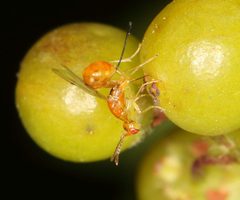
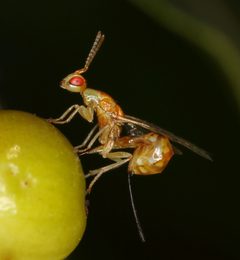
Megastigmus transvaalensis is a minute chalcid native to South Africa that has become in Mexico, Brazil, and Chile. are yellowish-brown with pronounced in size. The is a seed that targets drupes of Rhus species in its native range and has shifted to Schinus species in South America, with significant implications for and native plant conservation.
Pronunciation
How to pronounce Megastigmus transvaalensis: /mɛˈɡæstɪɡməs trænsvɑːˈlɛnsɪs/
These audio files are automatically generated. While they are not always 100% accurate, they are a good starting point.
Identification
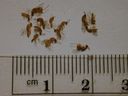
Distinguished from other Megastigmus by combination of yellowish-brown coloration, specific size range (males 2.3–2.9 mm, females 3.1–3.4 mm), and association with drupes of Rhus or Schinus species. The ovipositor length relative to body size is a key diagnostic feature for females. Accurate identification requires examination of morphological characters and host plant association.
Images
Habitat
Associated with containing plants: in South Africa, areas with Rhus angustifolia and Rhus laevigata; in South America, regions with Schinus terebinthifolius, Schinus molle, and Schinus polygamus. In Chile, found in areas with Cabrera . The inhabits environments where host plant drupes develop.
Distribution
Native to South Africa. Introduced and in Mexico, Brazil (first detected in Sorocaba municipality, São Paulo State in 2012), and Chile. The has established in these South American countries following its introduction.
Diet
Parasitizes developing seeds within drupes. In Africa, feeds on drupes of Rhus angustifolia and Rhus laevigata. In South America, parasitizes seeds of Schinus terebinthifolius, Schinus molle, and Schinus polygamus. In Chile, associated with Cabrera .
Host Associations
- Rhus angustifolia - (seed )Native African
- Rhus laevigata - (seed )Native African
- Schinus terebinthifolius - (seed ) in South America; poses threat to natural in Brazil
- Schinus molle - (seed )Target for proposed
- Schinus polygamus - (seed ) in South America
- Cabrera - (seed ) in Chile
Life Cycle
Develops within drupes of plants. females use the elongated ovipositor to oviposit into developing seeds. Larval development occurs within the seed, with of adults timed to host plant . Specific details of developmental stages and voltinism are not documented.
Behavior
Females use their elongated ovipositor to access seeds within drupes for oviposition. The has demonstrated -shifting following introduction to South America, moving from native African Rhus species to and native Schinus species.
Ecological Role
Seed that reduces seed viability of plants. In its range, may function as an inadvertent agent for invasive Schinus while simultaneously threatening native Schinus terebinthifolius in Brazil. The species illustrates complex ecological interactions involving host shifts and unintended consequences of species introductions.
Human Relevance
Proposed as a agent for Schinus molle . However, its presence in Brazil threatens natural of native Schinus terebinthifolius, creating a conservation dilemma. First detected in Brazil in 2012 by Dr. Paul Hanson. The exemplifies challenges in predicting outcomes of biological control introductions and managing that affect both native and introduced plant populations.
Similar Taxa
- Other Megastigmus speciesSimilar minute size and chalcid ; distinguished by association, size ranges, and ovipositor proportions
- Torymidae (family)Formerly classified in Torymidae; Megastigmidae now recognized as distinct based on morphological and molecular data
More Details
Taxonomic History
Originally described by Hussey in 1956. Formerly placed in Torymidae, now classified in Megastigmidae based on revised understanding of chalcidoid .
Conservation Implications
The presents a case study in the complexities of : while potentially beneficial for controlling Schinus molle, it simultaneously threatens native Schinus terebinthifolius in Brazil, highlighting the difficulty of predicting range and ecological impacts of introduced .