
Leucospis birkmani
Brues, 1925
Leucospis birkmani is a of parasitic wasp in the Leucospidae, a group notable for being unusually large among chalcidoid wasps. Like other leucospids, it is an external of solitary bees and . The female possesses a distinctive whip-like ovipositor that curves over the top of the , which she uses to drill through wood and deposit in nests. The species occurs in the southern United States including Arizona, Florida, and Texas.
Pronunciation
How to pronounce Leucospis birkmani: /lʊˈkɒspɪs ˈbɜːrk.mə.naɪ/
These audio files are automatically generated. While they are not always 100% accurate, they are a good starting point.
Identification
Easily mistaken for vespid such as mason wasps due to similar black and yellow coloration and longitudinal wing folding. Distinguished from Vespidae by the greatly swollen, toothed hind . Distinguished from other chalcidoids by its relatively large size ( Leucospidae ranges 3–14 mm). Females uniquely identified by the dorsally-curled ovipositor, unlike the rear-facing or underslung ovipositors of most parasitic wasps.
Images
Appearance
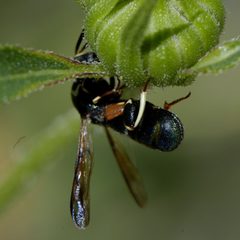
Medium-sized chalcidoid with black and yellow markings resembling mason or potter wasps. Front wings fold longitudinally when at rest. Hind are greatly swollen and toothed—a diagnostic feature of the . Females have a slender, whip-like ovipositor that curls back over the top of the ; males lack this structure and are smaller.
Habitat
Associated with containing nesting sites of solitary bees and , particularly those using pre-existing cavities in dead wood, hollow twigs, or similar substrates. The has been documented in association with nesting sites in wooden structures.
Distribution
Recorded from Arizona, Florida, and Texas in the United States.
Diet
feed on nectar from flowers such as wild carrot. Larvae are of solitary and larvae, attaching externally and consuming the .
Host Associations
- Solitary bees (Megachilidae) - primary Includes leafcutter bees (Megachile), mason bees (Osmia), and resin bees (Dianthidium)
- Solitary wasps - Various nesting in pre-existing cavities
Life Cycle
Female drills through wood or other nest substrate to deposit in . First larva to hatch eliminates competing leucospid larvae or eggs in the same cell. The surviving larva attaches to the host larva and feeds externally, consuming the host over 7–12 days. occurs within 5 days inside the host's cocoon. takes 9–14 days; late-season may overwinter as pupae. Adult size varies with host larva size.
Behavior
Females search for nests by tapping and drumming against substrate surfaces to locate larvae within. Upon locating a suitable host , the female unsheathes her ovipositor and drills through wood, cardboard tubes, or other materials to access the cell. Multiple may be laid across different host nests. The first-hatching larva exhibits aggressive toward siblings, ensuring solitary occupation of the host cell.
Ecological Role
regulating of solitary bees and . Part of the natural associated with and other cavity-nesting hymenopteran . Contributes to nutrient cycling through consumption.
Human Relevance
Potential pest of managed used for pollination services. May be observed by naturalists at wooden structures with of nesting solitary bees and . No direct economic importance otherwise documented.
Similar Taxa
- Leucospis affinisMost common and widespread North American leucospid; shares black and yellow coloration, swollen hind , and dorsally-curved ovipositor in females. L. birkmani distinguished by geographic distribution and potentially subtle morphological differences, though detailed comparative descriptions are limited in available sources.
- Monobia quadridens (Four-toothed Mason Wasp)Similar black and yellow coloration and longitudinal wing folding at rest. Distinguished by lack of swollen hind and presence of four teeth on ; not a chalcidoid .
- Chrysis spp. (cuckoo wasps)Also parasitic associated with solitary and wasp nests. Distinguished by brilliant metallic blue-green coloration, very dense , and ability to roll into defensive ball; lacks dorsally-curved ovipositor and swollen hind .
More Details
Taxonomic note
The Leucospis contains six North American , all in the Leucospidae. These represent some of the largest members of the superfamily Chalcidoidea, which otherwise consists predominantly of minute parasitic .
Ovipositor mechanics
The dorsally-curved ovipositor of female leucospids is anatomically unusual among Hymenoptera. The female must split open the to extend this structure, which she then uses to drill through surprisingly dense materials including solid oak wood to reach larvae.