
Hemiptarsenus
Westwood, 1833
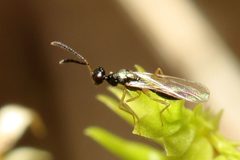
Hemiptarsenus is a of small in the Eulophidae. in this genus are primarily known as larval parasitoids of leaf-mining flies (Diptera: Agromyzidae), with some species also attacking Lepidopteran . The genus has been studied extensively for its potential in of agricultural pests, particularly leafminers affecting vegetable crops. Multiple species have been described from Asia, with new species continuing to be discovered in China.
Pronunciation
How to pronounce Hemiptarsenus: /hɛmɪpˈtɑrsənəs/
These audio files are automatically generated. While they are not always 100% accurate, they are a good starting point.
Identification
Members of Hemiptarsenus can be distinguished from other Eulophidae by morphological characters detailed in taxonomic keys. The Chinese fauna includes at least four described , with diagnostic features provided in species-level keys based on female . Separation from closely related genera requires examination of wing venation, structure, and body proportions.
Images
Habitat
Agricultural and horticultural environments, particularly vegetable cropping systems and rice areas. Associated with plants of agromyzid leafminers including bean, cucumber, and various leafy vegetables. Field have been documented in highland vegetable areas at elevations of 900–1500 m.
Distribution
Documented from Asia (China, Indonesia, India, Japan), Australia, and North America (California). The has been recorded as 'worldwide' in distribution for some economically important . Specific distribution records include Beijing, California, Kerala (India), and various locations in Indonesia and Japan.
Host Associations
- Liriomyza trifolii - larval ectoparasitoidprimary ; major pest of vegetable crops worldwide
- Liriomyza huidobrensis - larval ectoparasitoidpotato leafminer; major pest in Indonesia and other regions
- Liriomyza bryoniae - larval ectoparasitoiddevelopmental ; 8.8–9.0 days -to- at 25°C
- Liriomyza sativae - larval ectoparasitoidvegetable pest in Indonesia
- Helcystogramma arotraeum - solitary endoparasitoidrice leaf folder (Lepidoptera); of H. orizae in Kerala, India
Life Cycle
Development is holometabolous with , larval, prepupal, pupal, and stages. Egg-to-adult development at 27°C requires approximately 7.5–7.9 days; at 25°C, 8.6–9.0 days depending on and sex. Lower developmental threshold temperatures range from 8.2–8.9°C. The egg stage lasts approximately 24 hours, larval stage 48 hours, and pupal stage 120 hours at 28°C. time under laboratory conditions is approximately 13.6–13.9 days.
Behavior
females exhibit three distinct -killing : reproductive parasitization (oviposition leading to offspring development), non-reproductive host feeding (consumption of host fluids without oviposition), and host stinging without subsequent oviposition or feeding. Host feeding is strongly correlated with activity, longevity, and total host mortality. Females are synovigenic, emerging with minimal mature (ovigeny index ~0.003) and maturing additional eggs throughout adult life. Host-searching behavior intensifies when new host larvae become available; females preferentially attack third-instar larvae over second-instar larvae for both parasitization and paralysis. to host follows Type II pattern. has been observed.
Ecological Role
Important agent of agromyzid leafminer pests in agricultural systems. -level rates of 39–50% have been documented in field conditions. -dependent parasitism response to leafminer abundance contributes to natural pest suppression. The serves as a key component of programs for vegetable crops and rice.
Human Relevance
Significant economic importance as a biocontrol agent for leafminer pests affecting vegetable production. Used in classical and programs worldwide. Susceptibility to commonly used in vegetable crops has been evaluated to guide strategies. food quality affects performance, with implications for mass-rearing protocols. Geographic show genetic variation and potential reproductive incompatibility, relevant to biocontrol agent selection and release programs.
Similar Taxa
- Diglyphus isaeaAlso an eulophid of agromyzid leafminers; frequently compared in studies and trials. Distinguished by morphological characters and behavioral differences in utilization.
- Gronotoma micromorphaAnother eulophid of Liriomyza leafminers in Indonesian vegetable systems; co-occurs in field and biocontrol research.
More Details
Population Genetics
Geographic from different elevations in Indonesia (Pandai Sikek 900–1000 m, Alahan Panjang 1200–1300 m, Kayu Aro 1400–1500 m) show high genetic variation with similarity coefficients of 30–70%. Reproductive incompatibility has been demonstrated between some populations.
Environmental Effects on Fitness
Female varies with elevation of origin, temperature, and plant. from Kayu Aro (highest elevation) showed greatest longevity and . Optimal temperature for female maintenance is 23°C; fitness declines at 18°C and 28°C.
New Species Description
Two new from China were described in 2022: H. tianshuiensis and H. longjiangensis, bringing the known Chinese fauna to at least four species.
Sources and further reading
- BugGuide
- Wikipedia
- GBIF taxonomy match
- iNaturalist taxon
- NCBI Taxonomy
- Catalogue of Life
- Developmental Time of Ectoparasitoid, Hemiptarsenus varicornis, on Liriomyza trifolii and L. bryoniae.
- Life history and life table of the host-feeding parasitoid Hemiptarsenus varicornis (Hymenoptera: Eulophidae)
- New host and distribution records of Hemiptarsenus orizae Narendran (Hymenoptera, Eulophidae) from Kerala, India
- Reproduksi Hemiptarsenus varicornis (Hymenoptera: Eulophidae) : pengaruh ketinggian tempat, suhu dan tanaman inang terhadap keperidian
- Toxicity of Chemicals Commonly Used in Indonesian Vegetable Crops to Liriomyza huidobrensis Populations and the Indonesian Parasitoids Hemiptarsenus varicornis, Opius sp., and Gronotoma micromorpha, as well as the Australian parasitoids Hemiptarsenus varicornis and Diglyphus isaea
- PARAMETER DEMOGRAFI PARASITOID HEMIPTARSENUS VARICORNIS (GIRAULT) (HYMENOPTERA: EULOPHIDAE) PADA LALAT PENGOROK DAUN LIRIOMYZA HUIDOBRENSIS (DIPTERA : AGROMYZIDAE)
- Two new species of Hemiptarsenus Westwood (Hymenoptera, Eulophidae) from China, with a key to Chinese species
- Juvenile and Sublethal Effects of Selected Pesticides on the Leafminer Parasitoids Hemiptarsenus varicornis and Diglyphus isaea (Hymenoptera: Eulophidae) from Australia
- Biology of Hemiptarsenus varicornis (Hymenoptera : Eulophidae), A Parasitoid Wasp of the Leafminer Liriomyza trifolii (Diptera : Agromyzidae)
- Toxicity of Chemicals Commonly Used in Indonesian Vegetable Crops to <I>Liriomyza huidobrensis</I> Populations and the Indonesian Parasitoids <I>Hemiptarsenus varicornis</I>, <I>Opius</I> sp., and <I>Gronotoma micromorpha</I>, as well as the Australian parasitoids <I>Hemiptarsenus varicornis</I> and <I>Diglyphus isaea</I>
- Improving Parasitoid Performance by Improving Adult Food Quality : A Case Study for the Leafminer Parasitoid Hemiptarsenus varicornis (Hymenoptera : Eulophidae)
- Perkembangan Pradewasa dan Perilaku Parasitisasi Hemiptarsenus varicornis (Girault) (Hymenoptera: Eulophidae) sebagai Ektoprasitoid Larva Liriomyza sativae (Blanchard) (Diptera: Agromyzidae)
- PREFERENSI DAN TANGGAP FUNGSIONAL PARASITOID HEMIPTARSENUS VARICORNIS (GIRAULT) (HYMENOPTERA: EULOPHIDAE) PADA LARVA LALAT PENGOROK DAUN KENTANG
- PARASITISME HEMIPTARSENUS VARICORNIS (GIRAULT) (HYMENOPTERA: EULOPHIDAE) TERHADAP LALAT PENGOROK DAUN LIRIOMYZA HUIDOBRENSIS (BLANCHARD) (DIPTERA: AGROMYZIDAE) PADA TANAMAN KACANG ENDUL (PHASEOLUS VULGARIS L.) DI CILOTO, JAWA BARAT
- KERAGAMAN GENETIK, KEBUGARAN DAN INKOMPATIBILITAS REPRODUKSI Hemiptarsenus varicornis Girault (Hymenoptera: Eulophidae), PARASITOID LARVA Liriomyza huidobrensis (Diptera: Agromyzidae)