
Dirhinus
Dalman, 1818
Dirhinus is a of chalcidid wasps comprising approximately 70 described with worldwide distribution. These are pupal of Diptera, particularly flies associated with decomposing vertebrate matter, including species such as house flies, blow flies, and flesh flies, as well as agricultural pests like fruit flies. Females locate pupae in soil or substrate by digging with their horns and oviposit directly on the pupa within its . Several species, notably Dirhinus giffardii, have been investigated for applications against filth flies and fruit fly pests.
Pronunciation
How to pronounce Dirhinus: /dɪˈraɪnəs/
These audio files are automatically generated. While they are not always 100% accurate, they are a good starting point.
Identification
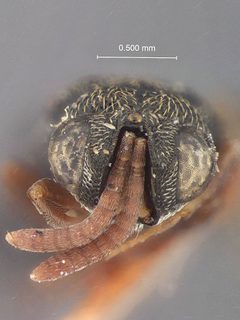
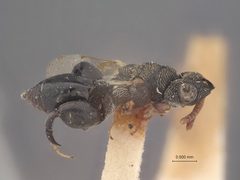
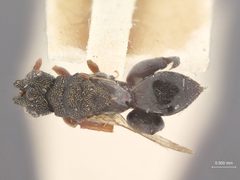
Dirhinus are distinguished within Chalcididae by the presence of prominent facial horns, which females use for digging to access pupae in soil. The is further characterized by its pupal lifestyle and association with cyclorrhaphous Diptera. Species-level identification requires examination of specific morphological characters; the genus has been organized into species groups including quadrhinus, himalayanus, claviger, anthracia, and hesperidum groups, with subgenera Pareniaca and Hontalia also recognized.
Images
Habitat
Associated with environments where flies pupate in soil or decaying organic matter, including vertebrate carcasses, decomposing plant material, and accumulated organic debris. In West Africa, has been documented in Black Soldier Fly production systems for waste recycling and animal feed.
Distribution
Worldwide distribution with records from Africa, Asia, the Indian Subcontinent, Hawaii, Fiji, Hungary, and the Americas. The quadrhinus group shows restricted distribution in Kenya.
Host Associations
- Calliphoridae - pupal flies developing in vertebrate corpses
- Sarcophagidae - pupal flesh flies; Dirhinus himalayanus documented in Sarcophaga dux
- Muscidae - pupal including Musca domestica (house fly)
- Tephritidae - pupal fruit flies including Bactrocera zonata, B. dorsalis, and Zeugodacus cucurbitae
- Glossinidae - pupal
- Hermetia illucens - pupal Black Soldier Fly; first reported in Ghana and Mali production systems
- Peckia (Euboettcheria) collusor - pupal Sarcophagidae; Dirhinus anthracia associated in Brazil
Life Cycle
Pupal : females target flies during the pupal stage after larval development is complete. The digs through soil or substrate using her horns to reach the pupa, then oviposits on the body of the fly pupa within its . Development occurs within the host puparium.
Behavior
Females dig in soil using facial horns to locate pupae. Dirhinus giffardii does not kill the host immediately upon oviposition, allowing the host pupa to continue developing until the larva hatches. In competitive interactions with Pachycrepoideus vindemmiae, Dirhinus giffardii is typically subordinate due to the competitor's venom that paralyzes hosts and kills competing larvae. Dirhinus giffardii shows preference for unparasitized hosts over those previously parasitized by competitors.
Ecological Role
agent for filth flies and fruit flies. reduction of 70% has been documented in house fly populations through pupal . In , such as Dirhinus himalayanus may be relevant when corpses are in advanced stages of decay. In insect farming systems, can significantly impact production: reduced Black Soldier Fly broodstock by 72% in West African facilities.
Human Relevance
Investigated and applied as a biocontrol agent for flies that human and animal , offering an alternative to chemical control methods. Of concern in commercial insect farming operations, particularly Black Soldier Fly production for waste management and animal feed. Potential applications in criminal investigations.
Similar Taxa
- Pachycrepoideus vindemmiaeBoth are solitary pupal of cyclorrhaphous Diptera; distinguished by Dirhinus giffardii's delayed killing versus permanent host paralysis at oviposition in P. vindemmiae, and competitive subordination of D. giffardii due to P. vindemmiae venom effects
- Brachymeria podagricaBoth parasitize Sarcophaga dux; D. himalayanus develops as pupal while B. podagrica attacks earlier larval stages, with different competitive outcomes in mixed
- Nasonia vitripennisBoth are pupal of flesh flies; N. vitripennis dominates in competitive interactions, preventing D. himalayanus development in simultaneous
More Details
Biocontrol efficacy
Dirhinus giffardii has shown and longevity two-fold higher on house fly pupae compared to tephritid primary , with female-biased progeny sex ratio (74% female) and increased female production on house flies. Optimal parasitism occurs on 2- to 3-day-old host where host pupae have fully formed.
Taxonomic organization
The comprises approximately 70 described organized into subgenera Dirhinus (with species groups quadrhinus, himalayanus, claviger, anthracia, and hesperidum), Pareniaca, and Hontalia. Five new species were described from Kenya in the quadrhinus group, characterized by distinctive four-horned .
Sources and further reading
- BugGuide
- Wikipedia
- GBIF taxonomy match
- iNaturalist taxon
- NCBI Taxonomy
- Catalogue of Life
- Dirhinus giffardii (Hymenoptera: Chalcididae), parasitoid affecting Black Soldier Fly production systems in West Africa
- Chalcid Hymenopteran parasitoid Dirhinus giffardii Silvestri proficiently disturbed house fly production
- Effects of Host and Parasitoid Ages on Parasitism Efficiency of Dirhinus giffardii (Silvestri)1 against Zeugodacus cucurbitae2
- Functional response of the pupal parasitoid, Dirhinus giffardii towards two fruit fly species, Bactrocera zonata and B. cucurbitae
- Exposure Time and age Links Parasitism, Emergence and Development of Pupal Parasitoid Dirhinus giffardii Against Bactrocera zonata
- Host-Parasite Relationship of Dirhinus pachycerus Masi (Hymenoptera: Chalcididae), with Particular Reference to Its House Fly Control Potential
- Four-horned wasps, description of some remarkable Dirhinus (Hymenoptera, Chalcididae) from Kenya, with a discussion of their taxonomic placement
- Indian calcid wasps (Hymenoptera) of the genus Dirhinus Parasitic on synanthropic and other Diptera
- Development and Competition of Three Parasitoid Wasps, Brachymeria podagrica, Dirhinus himalayanus, and Nasonia vitripennis, in Their Host, Sarcophaga dux, in Single and Mixed Infections
- Parasitism preference of Chalcid hymenopteran Dirhinus giffardii (Silvestri) confirms higher parasitism against housefly (Musca domestica) (Diptera: Muscidae) pupae
- Impacts of low temperatures, storage durations and food attractants in the parasitoid Dirhinus giffardii (Silvestri) and host Bactrocera zonata (Saunders)
- Aphaereta pallipes (Hymenoptera: Braconidae) and Dirhinus anthracia (Hymenoptera: Chalcididae) associated with Peckia (Euboettcheria) collusor (Diptera: Sarcophagidae) in Brazil
- Correction to: Aphaereta pallipes (Hymenoptera: Braconidae) and Dirhinus anthracia (Hymenoptera: Chalcididae) associated with Peckia (Euboettcheria) collusor (Diptera: Sarcophagidae) in Brazil
- Two different life-history strategies determine the competitive outcome between Dirhinus giffardii (Chalcididae) and Pachycrepoideus vindemmiae (Pteromalidae), ectoparasitoids of cyclorrhaphous Diptera
- Effect of Host Pupae Age and Depth in Plant Debris on the Searching Efficiency of Pupal Parasitoid Dirhinus giffardii (Silvestri) on Oriental Fruit Fly Bactrocera dorsalis (Hendel)