
Dirhininae
Ashmead, 1904
Genus Guides
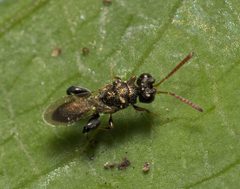
1Dirhininae is a of chalcidid wasps established by Ashmead in 1904, containing four and over 100 , many of which remain undescribed. Members of the tribe Dirhinini are distinguished by a pair of prominent horns and are primarily distributed in tropical regions. These are that develop within various flies, with the wasp using its horns, , and robust body to forcefully emerge from the .
Pronunciation
How to pronounce Dirhininae: //daɪˈraɪnɪniː//
These audio files are automatically generated. While they are not always 100% accurate, they are a good starting point.
Identification
The presence of paired horns distinguishes members of the tribe Dirhinini from other chalcidid wasps. The Dirhininae as a whole contains four , but diagnostic features separating it from other chalcidid subfamilies are not specified in available sources.
Images
Appearance
Members of the tribe Dirhinini possess a distinctive pair of horns on the . The body is described as heavy or robust. Additional morphological details for the as a whole are not documented.
Habitat
Tropical regions. Specific microhabitat preferences are not documented.
Distribution
Primarily tropical. Precise geographic boundaries are not established in available sources.
Host Associations
- various Brachycera - Develops as within flies; uses horns, , and heavy body to emerge from host
Life Cycle
Develops as within insects, specifically various flies. from host involves mechanical use of horns, , and body mass.
Behavior
use their horns, , and heavy body in a coordinated manner to emerge from the insect.
Ecological Role
of flies, contributing to of these dipteran .
Similar Taxa
- other Chalcididae subfamiliesDirhinini within Dirhininae are distinguished by the presence of paired horns, which are absent in other chalcidid groups
More Details
Taxonomic composition
The contains four , with the tribe Dirhinini being the most notably characterized group. Many remain undescribed, suggesting substantial undocumented diversity.
Emergence mechanism
The use of horns for from the is a distinctive behavioral and morphological not commonly reported in other .