
Schizocerella
Forsius, 1927
purslane sawflies
Species Guides
2- Schizocerella lineata(Outer Purslane Sawfly)
- Schizocerella pilicornis(purslane sawfly)
Schizocerella is a of in the Argidae containing at least two : Schizocerella pilicornis and Schizocerella lineata. Both species are associated with purslane (Portulaca) as plants. The genus was historically confused, with S. lineata only recognized as distinct from S. pilicornis in 2007 based on mitochondrial analysis. Males are readily identified by their uniquely forked terminal antennal segments.
Pronunciation
How to pronounce Schizocerella: /ˌskɪzoʊsəˈrɛlə/
These audio files are automatically generated. While they are not always 100% accurate, they are a good starting point.
Identification
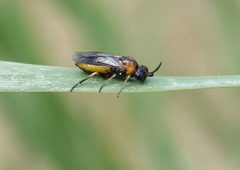
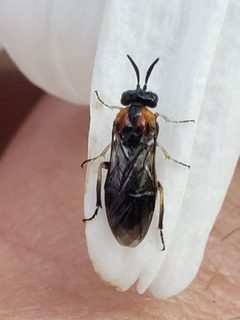
Males are distinguished from all other Argidae worldwide by the forked last antennal segment, creating the appearance of four . Females of S. pilicornis have a solid or nearly solid black stripe down the center of the red or orange , constricted at the middle; females of S. lineata have reduced black markings along the thoracic midline and are slightly larger (approximately 7 mm versus 5–6 mm for S. pilicornis).
Images
Habitat
Associated with purslane (Portulaca oleracea) and related Portulaca in open, disturbed including agricultural fields, gardens, and weedy areas.
Distribution
Widespread in the New World from southern Canada through the United States to Central America; S. pilicornis occurs at least as far south as Argentina. U.S. records include Arizona, California, Colorado, Connecticut, Florida, Indiana, Iowa, Kansas, Maine, Maryland, Michigan, Minnesota, Mississippi, Nebraska, New Hampshire, New Jersey, Ohio, Oregon, Texas, Virginia, and Washington. S. pilicornis may be in North America, originally described from South America.
Seasonality
Multiple annually, with up to six or seven generations reported in Illinois. have been observed in September. occurs as pupae.
Diet
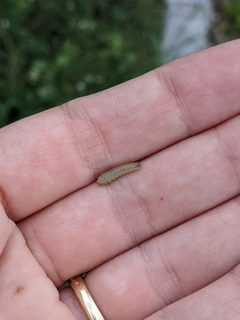
Larvae feed on purslane (Portulaca oleracea). S. pilicornis larvae are internal leaf miners; S. lineata larvae feed externally on leaves.
Host Associations
- Portulaca oleracea - larval plantcommon purslane; primary for both
Life Cycle
Females insert single into purslane leaves using the saw-like ovipositor. Larvae feed for approximately six days through five instars. Mature larvae tunnel into soil to about 3.5 cm depth to pupate. Summer emerge after one week; other generations overwinter as pupae. Adult lifespan is approximately 24 hours.
Behavior
have been observed resting on grasses and vegetation at sunset. Males are frequently encountered in this resting posture.
Ecological Role
Exerts minor on purslane in agricultural and garden settings.
Human Relevance
Considered a potential agent for common purslane, a widespread agricultural weed. Not a pest of cultivated crops.
Similar Taxa
- Other Argidae generaMales of Schizocerella are uniquely distinguished by forked terminal antennal segments; other lack this trait.
More Details
Species recognition history
Until 2007, external-feeding larvae were considered a feeding morph of S. pilicornis. Mitochondrial analysis demonstrated these represent a distinct , S. lineata (Hartsough et al., 2007).
Taxonomic note
The was established by Forsius in 1927.