
Schizocerella lineata
(Rohwer)
Outer Purslane Sawfly
Schizocerella lineata is a in the Argidae, historically confused with S. pilicornis until mitochondrial analysis confirmed their separation in 2007. Unlike its , whose larvae are internal leaf miners, S. lineata larvae feed externally on purslane leaves. The species occurs widely across the New World from southern Canada to at least Central America, with multiple annually in warmer regions.
Pronunciation
How to pronounce Schizocerella lineata: /ˌskɪtsɵˈsɛrələ lɪˈniːətə/
These audio files are automatically generated. While they are not always 100% accurate, they are a good starting point.
Identification
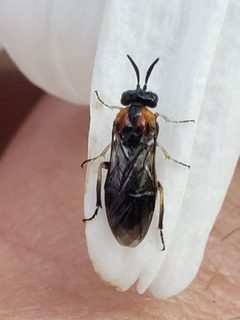
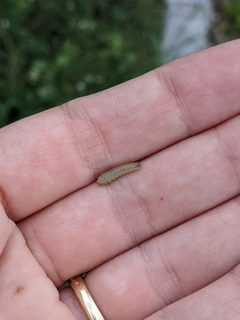
Females distinguished from S. pilicornis by reduced black markings on the thoracic midline versus a solid black stripe; slightly larger body size (7 mm vs. 5-6 mm). Males identified by forked terminal antennal segments. Larvae feed externally on leaves rather than internally mining tissue, separating them from S. pilicornis larvae.
Images
Appearance
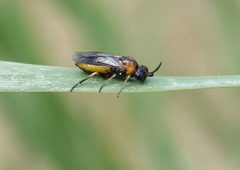
females average approximately 7 mm in length, slightly larger than S. pilicornis females (5-6 mm). The is predominantly red or orange with very reduced black markings along the midline, distinguishing females from S. pilicornis which has a solid or nearly solid black stripe constricted in the middle. Males possess distinctive forked last antennal segments, appearing as four rather than two.
Habitat
Associated with purslane (Portulaca oleracea) as plant. observed resting on grasses and vegetation at sunset. Larval consists of external leaf surfaces of purslane plants.
Distribution
Widespread in the New World, ranging from southern Canada to at least Central America. U.S. records include multiple states across diverse regions; may be in North America with possible South American origin.
Seasonality
Up to six or seven annually in Illinois, with continuous activity during warmer months. emerge from pupae after approximately one week during summer generations; occurs as pupae in soil.
Diet
Larvae feed externally on leaves of common purslane (Portulaca oleracea). do not feed; lifespan approximately 24 hours.
Host Associations
- Portulaca oleracea - larval plantexternal leaf feeding
Life Cycle
Females insert single into purslane leaves using saw-like ovipositor. Larvae progress through five instars over approximately six days, feeding externally on leaf tissue. Mature larvae burrow into soil to approximately 3.5 cm depth to pupate. Summer emerge after one week; pupae produce adults the following season.
Behavior
rest on vegetation at sunset and during inclement weather. Females oviposit singly into plant leaves. Larvae feed externally and may move between plants. Mature larvae exhibit wandering before soil burrowing for .
Ecological Role
Acts as a minor agent against purslane, a widespread agricultural weed. Contributes to local regulation of purslane , though impact is generally small.
Human Relevance
Potential value in of common purslane in agricultural and horticultural settings. No significant negative impacts documented; not known to sting or cause direct harm to humans.
Similar Taxa
- Schizocerella pilicornisHistorically confused with S. lineata; distinguished by female thoracic markings (solid black stripe vs. reduced markings), smaller size, and internal leaf-mining larvae versus external feeding
More Details
Taxonomic History
Formerly considered with S. pilicornis; recognized as distinct in 2007 based on mitochondrial analysis by Hartsough et al.
Adult Longevity
lifespan extremely brief, approximately 24 hours according to Gorske & Hopen (1976)
Sources and further reading
- BugGuide
- iNaturalist taxon
- NCBI Taxonomy
- Ready for Moth Night at UC Davis? | Bug Squad
- A Buggy New Year! | Bug Squad
- Bug Eric: Wasp Wednesday: Purslane Sawflies
- Oklahoma is More than OK for Burying Beetles
- Bug Eric: White-lined Sphinx ("Hummingbird Moth")
- Catch a Glimpse of Caterpillars During National Moth Week