
Epeolus scutellaris
Say, 1824
red-chested cuckoo nomad bee, Notch-backed Cellophane-cuckoo Bee
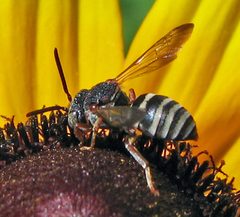
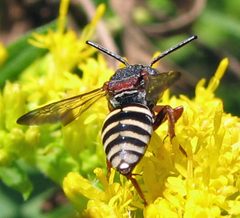
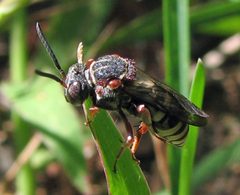
Epeolus scutellaris is a cleptoparasitic in the Apidae. As a cuckoo bee, it does not construct nests or collect pollen, instead laying in the nests of bees. The occurs in North America and Mexico. It is one of approximately 43 Epeolus species recognized in North America.
Pronunciation
How to pronounce Epeolus scutellaris: /ɛˈpiːələs skuːtɛˈlɛrɪs/
These audio files are automatically generated. While they are not always 100% accurate, they are a good starting point.
Images
Distribution
United States and Mexico.
Host Associations
- Colletes - Epeolus are known to parasitize nests of polyester bees in the Colletes
Ecological Role
of other bees. The functions as a nest , with larvae consuming provisions and killing host offspring.
Similar Taxa
More Details
Etymology
The name 'Epeolus' is probably a diminutive of Epeus/Epeius, the soldier in Greek mythology who devised the Trojan Horse, perhaps alluding to the deceptive, infiltrating nature of these cleptoparasitic bees.
Conservation status
No specific conservation assessment has been documented for this . Cuckoo bees are generally rarer than their species due to -prey dynamics.
Sources and further reading
- BugGuide
- Wikipedia
- GBIF taxonomy match
- iNaturalist taxon
- NCBI Taxonomy
- Catalogue of Life
- Hymenoptera | Blog - Part 4
- Cicindela scutellaris flavoviridis (chartreuse tiger beetle) | Beetles In The Bush
- Cicindela scutellaris lecontei x scutellaris unicolor intergrades in southeast Missouri | Beetles In The Bush