
Ericrocis pintada
Snelling & Zavortink, 1985
Painted Oil-digger-Cuckoo
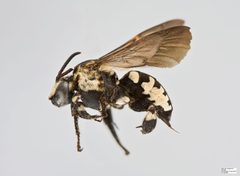
Ericrocis pintada is a of cleptoparasitic in the Apidae, tribe Ericrocidini. It is commonly known as the Painted Oil-digger-Cuckoo. The species is native to Central America and North America. Like other members of its tribe, it is presumed to be a nest of oil-collecting bees in the Centris, though specific records for this species are limited.
Pronunciation
How to pronounce Ericrocis pintada: /ˌɛrɪˈkroʊsɪs pɪnˈtɑːdə/
These audio files are automatically generated. While they are not always 100% accurate, they are a good starting point.
Identification
Distinguished from other Ericrocis by specific color pattern details referenced in the original description (Snelling & Zavortink, 1985). Separation from other cleptoparasitic bees in the same tribe (Ericrocis, Epicharis, etc.) requires examination of morphological characters including wing venation, facial markings, and genitalia. Can be distinguished from its (Centris species) by the absence of scopae on the hind legs and the generally more slender, less hairy appearance typical of cuckoo bees.
Images
Appearance
Medium-sized with a robust, somewhat hairy body typical of the tribe Ericrocidini. The specific epithet 'pintada' (Spanish for 'painted') suggests distinctive coloration or patterning, though detailed published descriptions of the ' are sparse. Females possess a stinger and lack pollen-collecting structures (scopae), consistent with cleptoparasitic habits. Males and females likely exhibit in size and possibly coloration.
Habitat
Distribution
Documented from Central America and North America. GBIF records indicate presence in Middle America (Mexico and Central America) and North America. The likely occurs in the southwestern United States and Mexico, extending southward through Central America, though precise range boundaries are not well established.
Seasonality
activity presumably coincides with the nesting period of Centris , which typically peaks in warm months. Specific period data are not available.
Host Associations
- Centris - presumed Ericrocidini are specialized of Centris; specific for E. pintada not documented
Behavior
Ecological Role
Acts as a regulator of oil-collecting bees. As a , it contributes to dynamics and may influence nesting and distribution of its Centris . Pollination services are incidental and minimal compared to non-parasitic bees.
Human Relevance
No direct economic importance. Of interest to biologists studying cleptoparasitism and oil-collecting bee . Observations contribute to understanding of bee diversity in poorly studied regions.
Similar Taxa
- Ericrocis lataCongeneric with similar cleptoparasitic ; distinguished by morphological details in original descriptions
- Epicharis spp.Other Ericrocidini with similar appearance and ; Epicharis are generally larger and have different wing venation
- Centris spp. bees that may be confused with E. pintada; Centris have dense scopae on hind legs for oil and pollen collection and more robust, hairier bodies
More Details
Taxonomic History
Described by Snelling and Zavortink in 1985 (or 1984 according to NCBI, though 1985 is the accepted date). The epithet 'pintada' refers to painted or marked appearance. The tribe Ericrocidini was formerly treated as a (Ericrocidinae) by some authors.
Research Needs
Specific records, detailed morphological description, and precise geographic distribution remain undocumented in readily accessible literature. The 47 iNaturalist observations suggest the is encountered with moderate frequency but is not well studied.