
Ericrocis
Cresson, 1887
Species Guides
2- Ericrocis lata(Common Oil-digger-Cuckoo)
- Ericrocis pintada(Painted Oil-digger-Cuckoo)
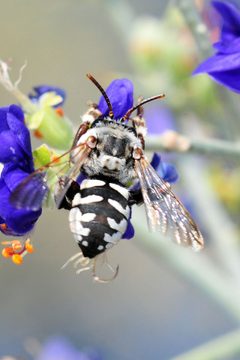
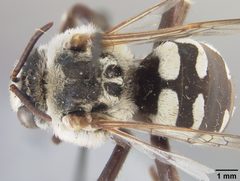
Ericrocis is a of kleptoparasitic bees in the Apidae, commonly known as centris-cuckoo bees. The genus comprises at least four described distributed in the southwestern United States and Mexico. As cuckoo bees, Ericrocis species do not construct their own nests but instead lay in the nests of bees, primarily in the genus Centris. The genus was established by Cresson in 1887 and belongs to the tribe Ericrocidini.
Pronunciation
How to pronounce Ericrocis: /ˌɛrɪˈkroʊsɪs/
These audio files are automatically generated. While they are not always 100% accurate, they are a good starting point.
Identification
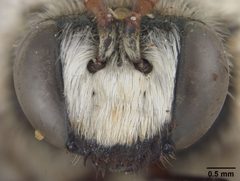
Ericrocis can be distinguished from their Centris by their generally more slender body form and reduced scopal hairs on the hind legs, as females do not collect pollen. They typically exhibit dense, often silvery or pale . Males may be distinguished by genitalic characters, though species-level identification often requires examination of subtle morphological features such as facial markings and wing venation.
Images
Habitat
Distribution
Southwestern United States (Arizona, California, New Mexico, Texas) and Mexico.
Seasonality
Diet
feed on nectar from flowers. Larvae consume provisions (nectar and pollen) stored in nests; females do not forage for pollen due to their kleptoparasitic lifestyle.
Host Associations
Life Cycle
Development occurs within nests. Females enter unguarded Centris nests and deposit in . Larvae consume the host's provisioned food stores, typically killing the host egg or larva. occurs within the host cell; emerge to mate and seek new host nests.
Behavior
Ecological Role
Kleptoparasite (cuckoo bee) of Centris bees; acts as a natural regulator of populations. Contributes to pollination indirectly through nectar feeding.
Similar Taxa
- MelectaAlso cuckoo bees in Apidae, but Melecta parasitizes Anthophora and related rather than Centris, and has different body proportions and patterns.
- Centris ; Ericrocis mimic Centris in general appearance but can be distinguished by reduced pollen-collecting structures and more slender build.